
A Surprising Finding from Brussels: Plastic Continues to Grow
In July 2026, the Joint Research Centre (JRC) of the European Commission published a comprehensive analysis of packaging volumes across 19 EU member states. The result surprises many market observers: plastic is the only packaging material group showing a clear growth trend between 2011 and 2025.
At the same time, it becomes clear that the debate around packaging needs to be conducted in a more nuanced way than is often the case in public discussion. While a move away from plastic is frequently proclaimed, the official data from the European Commission paints a different picture.
Europe Still Consumes Large Quantities of Packaging
In the countries examined, an average of around 98 kg of packaging material per inhabitant was placed on the market. Food and beverage packaging accounts for the largest share.
The study looks at:
- Plastics
- Glass
- Paper and cardboard
- Metals
- Composite materials
The development of the individual material groups is particularly interesting.
The “Winners”: Plastic Packaging
The core message of the study is:
Plastic is the only packaging category that grew across Europe between 2011 and 2025.
In 2025, around 5.9 million tonnes of plastic packaging were placed on the market in the countries examined. This corresponds to an average of about 14 kg per inhabitant.
Particularly strongly represented are:
- PET bottles for water and soft drinks
- PP packaging for food
- Packaging for dairy products
- Packaging for processed foods
PET remains the most significant single plastic in the consumer segment across Europe. In some countries, however – such as Finland, Ireland, the Netherlands and Sweden – polypropylene (PP) already matches or exceeds the significance of PET.
The Losers: Glass, Paper and Metal Are Stagnating
While the study does not name exact declines for individual material types, it explicitly states that only plastic shows a positive trend. From this it can be inferred that the other material groups either stagnated or declined over the period considered.
This is remarkable, because many political debates in recent years suggested that paper or glass packaging would massively replace plastic.
Reality appears to be considerably more nuanced:
- Paper is indeed growing in individual applications, but it is not replacing plastic across the board.
- Glass remains significant, especially for beverages.
- Metal packaging continues to play an important role, but is not growing dynamically.
Why Is Plastic Booming Despite the PPWR and the Circular Economy?
The answer lies in its physical properties.
Plastics offer:
- low weight
- high product protection
- a low CO₂ footprint in transport
- good barrier properties
- high design freedom
- efficient processing
These properties are decisive precisely in the flexible packaging segment. Flexible packaging often requires only a fraction of the material of comparable rigid packaging solutions.
Several international studies also conclude that, thanks to their resource efficiency, plastic packaging will continue to play a central role in many applications – but increasingly in circular-ready designs.
What Does This Mean for Flexible Packaging?
For the flexible packaging industry, the JRC analysis carries an important message:
1. Flexible packaging will not disappear
The market data shows that plastic packaging remains in demand. A blanket switch of materials is not taking place at the European level.
2. Mono-material solutions are gaining importance
The PPWR calls for better recyclability. This increases demand for:
- PE mono-material structures
- PP mono-material structures
- recycling-friendly barrier concepts
The trend is therefore shifting less away from plastic than towards more easily recyclable plastic solutions.
3. Barrier remains decisive
The largest packaging volumes are accounted for by beverages, dairy products and processed foods. It is precisely these applications that often require defined oxygen, water-vapour or aroma barriers.
Innovative flexible packaging concepts will continue to be needed here.
Germany in a European Comparison
Germany’s position is also interesting.
At around 16 kg of plastic packaging per capita, Germany lies above the average of the countries examined, which is about 14 kg per inhabitant.
Sweden, by contrast, records considerably lower figures. The differences show how strongly consumption habits, packaging systems and beverage markets influence material use.
Glass Remains a Heavyweight – Literally
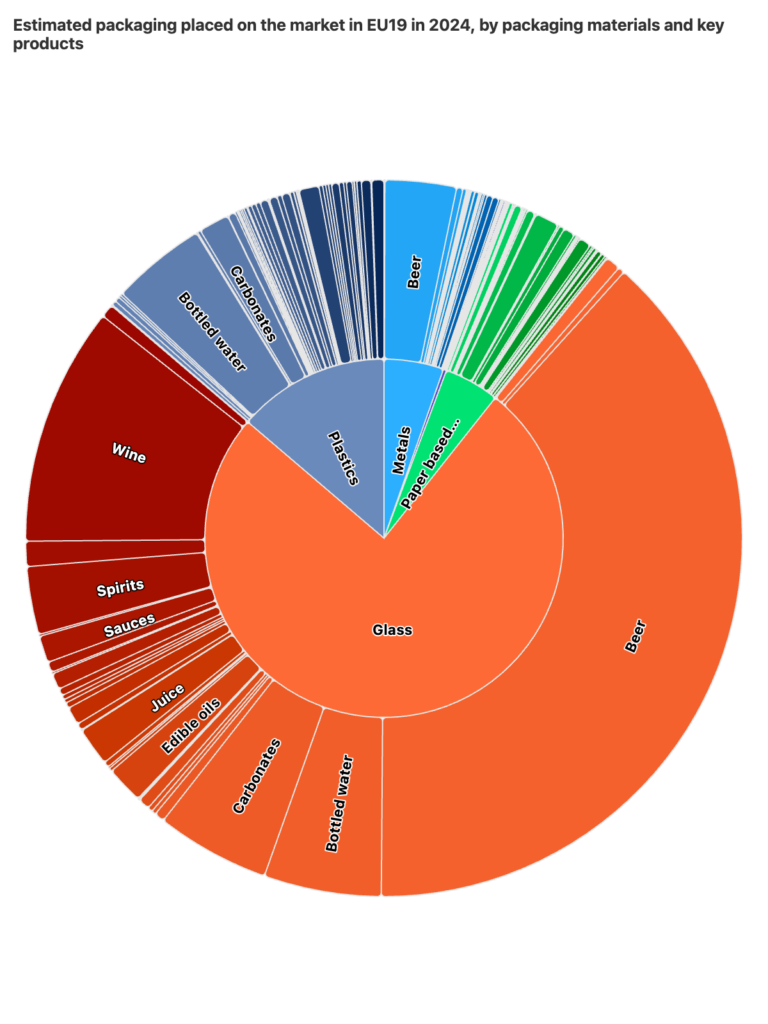
Although plastic is growing, glass continues to dominate the total weight of all packaging.
Around three quarters of the total packaging weight is accounted for by glass. This is due above all to its high material density. Beer bottles represent the single largest application here.
This once again illustrates an important point:
Weight does not equal environmental impact.
Despite good recyclability, glass packaging can cause considerable environmental impacts during production and transport because of its high weight. This is why European packaging policy increasingly calls for a holistic view across the entire life cycle of a package.
Conclusion: The Change Is Happening Within Plastic
The current analysis by the European Commission paints a distinctly different picture from parts of the public debate.
The decisive development is not:
“Away from plastic”
but rather:
“Towards better plastic”.
Plastic packaging continues to grow, while other material groups largely stagnate. For the flexible packaging industry, this confirms a strategic focus on:
- recyclable mono-materials
- reduced material use
- improved circularity
- high-quality barrier concepts
The future of packaging evidently lies not in replacing flexible plastic packaging, but in developing it intelligently.
“The real transformation is not taking place between materials, but within the material world of plastic – from hard-to-recycle multi-material structures towards circular-ready, resource-efficient packaging solutions.”
Editorial Assessment by Innoform
While the total volume of the packaging considered in the EU remained largely stable between 2011 and 2025, plastic was the only material group with clear volume growth. The JRC puts this growth at around 11% in absolute quantities. For glass, paper/cardboard, metals and mixed materials, the short publication reports no positive growth rates.
The results confirm a trend that many players in the flexible packaging industry are already observing: sustainability does not necessarily mean switching materials. Rather, functional, lightweight and recyclable packaging solutions are moving into focus. For manufacturers of flexible packaging, the central challenge is to optimise product protection, resource efficiency and recyclability at the same time. This is precisely where it will be decided which packaging concepts succeed in the market.
Joint Research Centre (JRC) of the European Commission
Estimating Packaging Placed on the Market at National Level (2026)
Joint Research Centre (JRC) of the European Commission
Packaging Estimates Model Results (Version 2.0)
Regulation (EU) 2025/40 on packaging and packaging waste (PPWR)
