
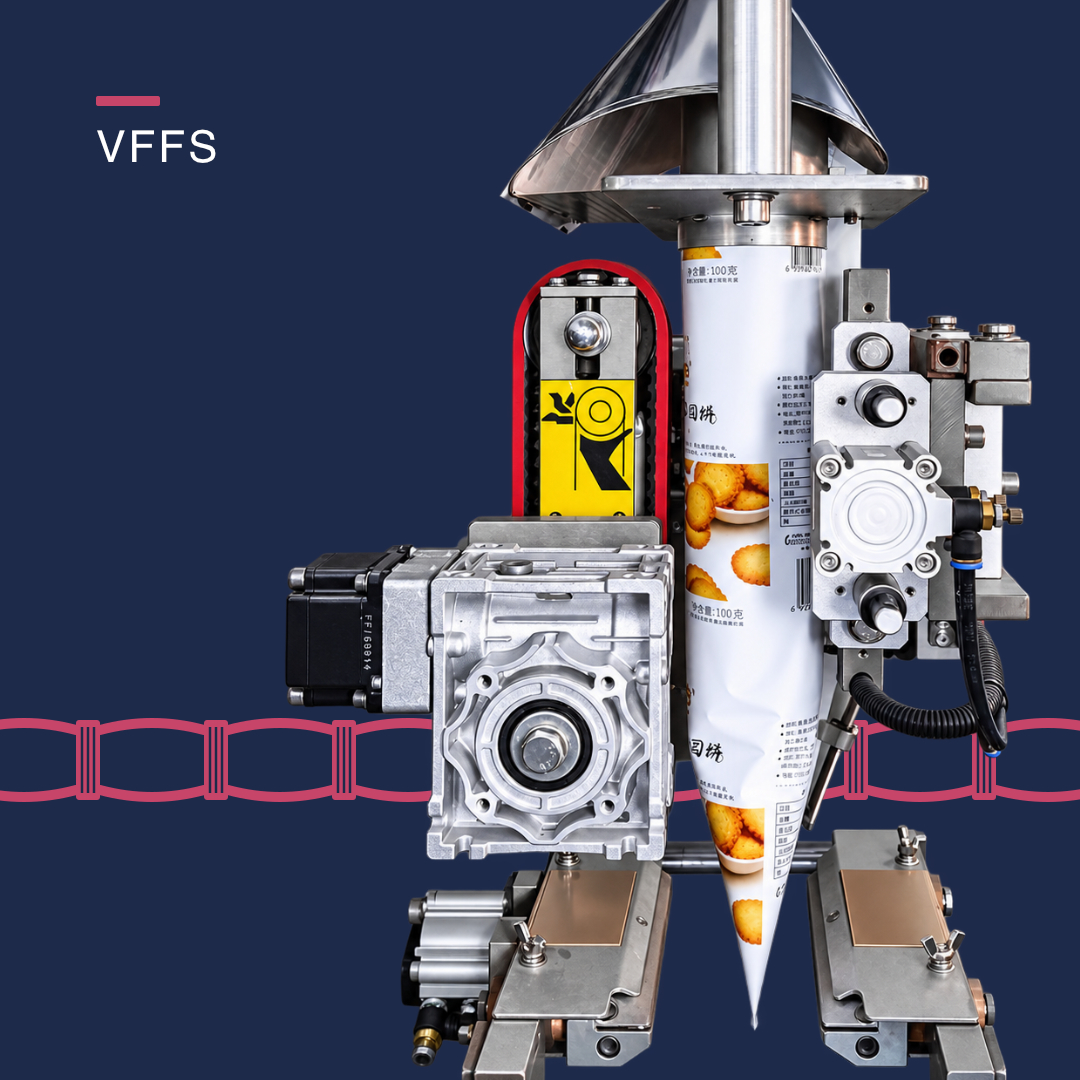
When packing in flexible packaging, it is not the packaging machine alone that determines a stable process. At least as important are the film construction, its friction, surface, and sealing properties, as well as the respective product being filled. Karsten Schröder demonstrated how closely these factors are linked in the Innoform web seminar “Packaging in Flexible Packaging, Part A: Vertical Form, Fill and Seal Machines”.
The focus was on vertical form, fill and seal machines, short VFFS or FFS machines. In addition to mechanical engineering fundamentals, the main focus was on a practical question: How can errors be identified, avoided, and systematically traced back to their root cause?
From Flat Film to Tubular Bag
In vertical FFS machines, a flat film web is formed into a tube via a former shoulder. Subsequently, the longitudinal seam as well as the top and bottom seals of the pouch are created. The product enters the packaging from above through the filling tube. So far, so clear.
What sounds simple at first places high demands on both material – whether film or paper – and machine. Creases or peak stresses can occur right at the former shoulder. This is particularly critical with materials that tear easily or propagate tears, such as paper or certain oriented plastic films.
The former shoulder must therefore be adapted to the material used, its stiffness, and its respective surface properties. Deposits from the film or from the production environment can also alter the friction conditions, leading to web tracking issues, wrinkles, or subsequent leaks.
Jaw Draw-Down or Belt Draw-Down?
One aspect of the web seminar was the difference between jaw draw-down and belt draw-down.
With jaw draw-down, the sealing units perform both sealing and transportation of the film tube simultaneously. In classic PET/PE laminates, the tensile force can be transferred relatively well via the thermally stable PET outer layer. In mono-materials, however, the melting points of the inner and outer layers are closer together. When sealing on the inside, the outer layer also becomes “soft and elastic”. As a result, the material can stretch more during draw-down and thus distort unfavorably.
With belt draw-down, the film is transported along the filling tube via driven belts. For this to work, the outer side must adhere sufficiently to the transport belt, while the inner side should slide smoothly over the filling tube with as little friction as possible. The right combination of static and dynamic friction is therefore crucial.
Correctly Evaluating Static and Dynamic Friction
The Coefficient of Friction, short COF, is an important parameter for the running behavior of a film. A distinction is made between static friction and dynamic friction.
Standard laboratory test methods provide reproducible comparative values. However, they reflect the real speeds of a packaging machine only to a limited extent. In addition, the result depends on which surfaces are tested against each other. A “film-to-film” measurement cannot simply be transferred to the behavior of the film on a metal former shoulder or filling tube.
For a meaningful error analysis, individual COF values should therefore not be viewed in isolation. The friction partner, surface texture, temperature, test speed, and possible deposits must also be taken into account.
Slip Agents Become a Challenge in Mono-Materials
Migrating slip agents significantly influence how well a film slides over the former shoulder and filling tube and can thus be conveyed. They migrate to the film surface after extrusion. This process depends, among other things, on formulation, storage time, temperature, corona treatment, and lamination adhesive.
In traditional multi-material laminates, a layer made of a different polymer can partially restrict migration. In mono-PE or mono-PP structures, however, the slip agent can move through the entire laminate and reach the outer surface as well. This alters the frictional properties and potentially the running behavior on existing FFS equipment.
Switching to recycling-oriented mono-materials is therefore not just a simple material change. The new film structure must be qualified for the specific packaging process and existing machinery, and not just fit the protection of the product being filled.
Antiblocking Agents Further Influence Processing
In addition to migrating slip agents, non-migrating antiblocking agents play an important role. They create a microscopically rough surface and prevent film surfaces from sticking together excessively.
At the same time, antiblocking agents can affect the migration of slip agents to the surface. Therefore, both additive types must be matched to the polymer formulation and the intended end use. Film properties are thus not determined by a single raw material, but by the interaction of various polymers, additives, and processing steps.
The Heat Seal Seam as a Critical Area
Special attention must be paid to the cross seal on vertical machines. The product often falls onto a still-warm heat seal. Therefore, hot tack strength, also known as hot tack, is of great importance for process reliability.
In addition, dust, fat, liquid, or product particles can enter the sealing zone. The film and the sealing layer must be designed in such a way that the seal closes as reliably as possible even under these conditions.
Another critical point is the transition between the longitudinal seal and the cross seal. Particularly in paper laminates with thin sealing layers, a channel can form there. In the web seminar, it was shown that a suitably selected, sufficiently flowable sealing layer can fill such areas more reliably.
Which Sealing Jaw Structure Is Suitable?
Smooth sealing jaws create visually appealing seals, but are not automatically the technically best solution for every application. Serrated or waffle-patterned structures can offer advantages in contaminated sealing zones because they displace product residue or dust during the sealing process and can distribute stress at the seal root.
Which geometry is suitable depends on the material, filling product, desired appearance, and actual process conditions. In the laboratory, smooth sealing jaws are often used. However, if a real machine seal is to be replicated, the same jaw geometry should be used if possible.
The Dosing System Also Affects the Film
Finally, the web seminar provided an overview of different dosing systems, including volumetric and auger feeders. These do not only determine the fill quantity. They also influence how much dust, fat, or liquid can reach the sealing zone.
This makes it clear: Reliable packaging is only created when film, filling product, dosing, and machine technology are considered together. Especially with powdery, fatty or moist products, the sealing layer must be able to tolerate potential contamination.
Conclusion: Analyzing Process Problems Holistically
Many supposed machine problems originate in the film, its construction or its interaction with the equipment. Conversely, a fundamentally suitable film can cause issues on an incorrectly adjusted or dirty machine.
In practice, this means:
- Machine type and draw-down method must be known as early as the film development stage.
- Former shoulder and filling tube must be checked regularly for condition and deposits.
- Static and dynamic friction must not be viewed in isolation.
- Mono-material structures must be re-qualified for the respective FFS machine.
- Seal seam, sealing jaw geometry and potential contamination must be evaluated together.
- Troubleshooting should take the entire process and supply chain into consideration.
The web seminar made it clear that successful packaging goes far beyond merely operating a machine. Only an understanding of the interrelationships between polymer, additives, film structure, surface, sealing, machine and product being filled enables robust and cost-effective packaging processes.
Watch Recording
The complete web seminar with Karsten Schröder (Innoform Coaching GmbH) on demand.
Watch now →Related Seminars
Packaging in flexible packaging
Discover topics →Material Analysis
Material identification of film materials, plastic packaging materials, multilayer films, or other plastic samples at Innoform Testservice.
To the lab →