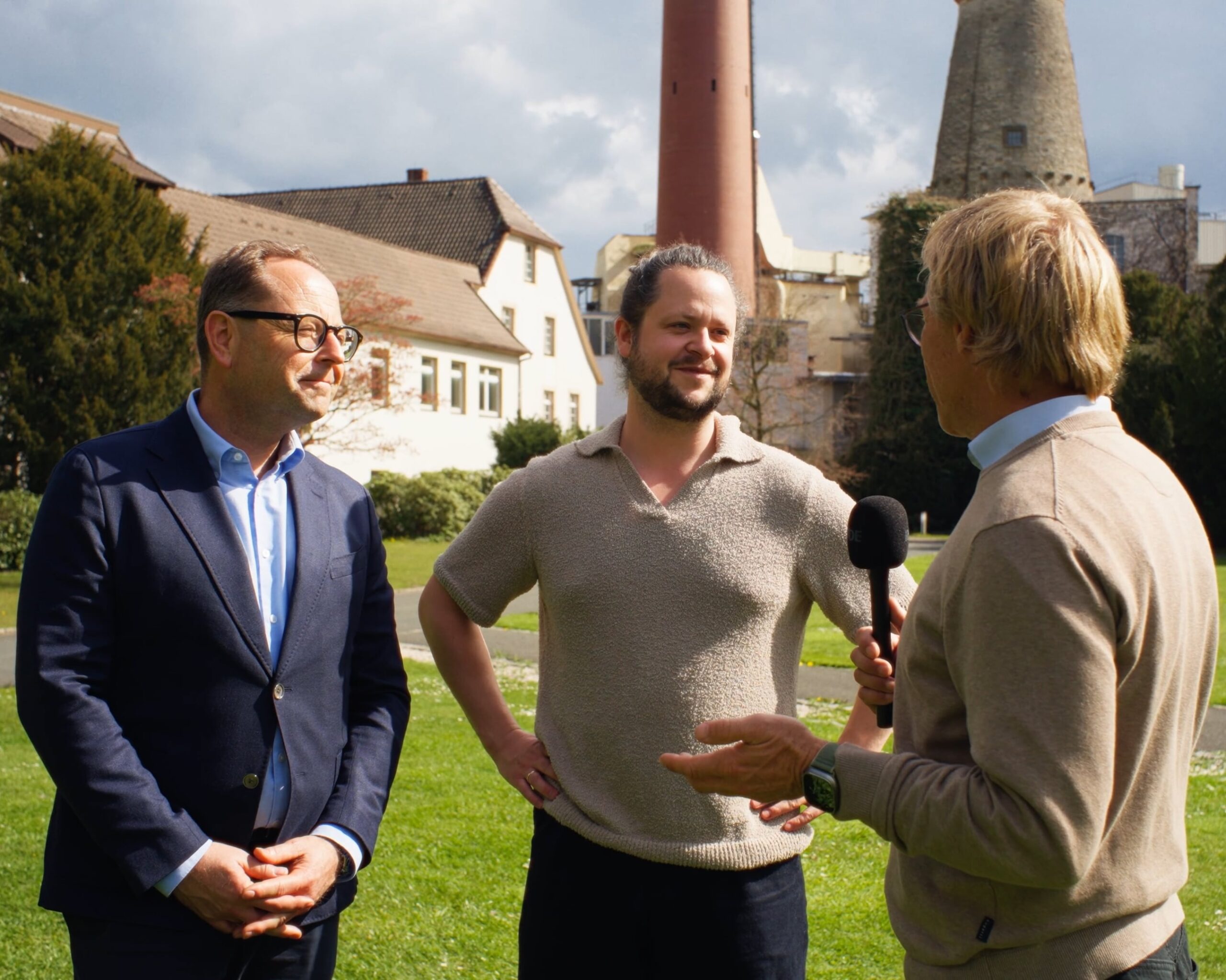
INNOFORM visits Felix Schoeller – Interview with Julian Thielen and Guido Hofmeyer
With the first INNO‑Fiber, Innoform has established a new industry event – and sent out a strong signal right from the start. Around 70 participants on site and 20 participants watching the livestream spent a day and a half of intensive discussions on paper-based packaging solutions, regulation, technology and collaboration across the entire value chain.
For Julian Thielen, the new managing director of Innoform Coaching, it was the first event he had conceived and organised entirely on his own. His verdict is clear: “Brilliant.”
A new format – and a strong team
From the outset, INNO‑Fiber was conceived as a platform for dialogue. The aim was not to deliver traditional keynote speeches, but to provide practical insights from people who truly believe in their topics. This is precisely what the participants highlighted as particularly positive: the quality of the presentations, the logical structure of the topics and the clear commitment of everyone involved.
The team-based approach also proved its worth from an organisational perspective. The programme, speakers and discussions flowed seamlessly into one another – and continued in the conversations that followed the presentations.
Host package: Experience the industry first-hand, rather than just listening
A special feature of INNO‑Fiber was the host package. Following the first day of the event at Innoform, a visit to Felix Schoeller was on the agenda for the second day. Host Guido Hofmeyer did not hesitate for a second to support this new format.
The idea behind it: not just to discuss paper for the flexpack market in theory, but to turn it into something that can be experienced first-hand in production. Hofmeyer soon realised that these were precisely the formats in demand:
“We need to talk to each other more. Events like INNO-Fiber bring together exactly the right people to really drive this change forward together.”
Guido Hofmeyer, Felix Schoeller
The second day of the event in particular demonstrated just how valuable this change of perspective is – moving straight from the lecture theatre to the machine.
Why INNO-Fiber? Paper is an exciting world for flexpack manufacturers
For a long time, Flexpack was virtually synonymous with plastic film. But that is changing fundamentally. Paper-based solutions are rapidly gaining in importance – driven by PPWR, sustainability targets and new market demands.
Julian Thielen sums it up: for many people in the film industry, paper is uncharted territory. There are uncertainties, gaps in knowledge – and sometimes resistance too. This is exactly where INNO‑Fiber comes in: to promote understanding, share knowledge and provide a dedicated space for this topic.
The entire value chain around one table
A frequently expressed wish at the Innoform conferences is for greater involvement from brand owners. The INNO-Fiber host package has achieved this. The participant profile was deliberately broad:
- Trademark owner
- Converter
- Mechanical engineer
- Paper manufacturer
- Supplier
- Regulatory experts
This diverse mix made the discussions particularly valuable – and led to new contacts and concrete ideas for future collaboration.
Why Tesa? Small components, big impact
Tesa participated as a sponsor, impressively demonstrating just how crucial seemingly small components can be. Adhesive tapes play a central role in roll changes, in processing and in the ongoing production of paper-based packaging.
It is precisely here that it becomes clear just how closely all the cogs must mesh for paper-based solutions to work reliably – a core principle of INNO‑Fiber.
PPWR, barriers and new paper-based solutions
The PPWR (Packaging and Packaging Waste Regulation) was a key topic at INNO‑Fiber. Felix Schoeller demonstrated how paper manufacturers are responding to this with a range of technologies:
- Thin PE extrusion coatings weighing up to 3 – 4 g/m²
- Multi-layer extrusion solutions
- Dispersions‑ und Curtain‑Coating‑Technologies
- Precise, application-specific barrier properties
The aim is to develop fibre-based packaging solutions that are both compliant with regulations and technically feasible.
Virgin fibre, recycled fibre – and openness
A key topic of discussion at INNO‑Fiber was the question of virgin fibre versus recycled materials. Felix Schoeller currently relies predominantly on virgin fibre – for functional reasons and due to its product history. At the same time, it was emphasised that the industry is undergoing change, and that an open-minded approach remains crucial.
Cooperation means more than just an exchange of ideas: it must be put into practice – including through external documents and joint approaches to solutions.
What’s next for INNO-Fiber?
Plans are already underway for the next edition of INNO-Fiber. Meanwhile, the next major Innoform event – INNO-Circle, taking place on 1 and 2 July 2026 in Würzburg – is just around the corner. The event will explore the topic of the circular economy in greater depth – including paper-based approaches.
One thing is clear following the first INNO‑Fiber:
The industry-wide dialogue has begun. The demand is there. And this format leaves us wanting more.
Here is the automatically translated interview:
Transkript
Inno-Fiber One is over, Julian. Your first self-organized, self-curated, self-moderated conference at Innoform as the new managing director. How was it for you? Yes, fantastic. So naturally, we had planned a lot beforehand. I think as a team, we were excellent together. Yesterday, we also had a good program, good speakers. Everything was well-structured and built on each other. And yes, it went really well. The conversations afterwards also showed it. So I’m very pleased.
We had about 70 attendees here and some more on the live stream, about 70, I think. That was also thanks to our head, Felix Scholer. We’re also speaking with Guido Hofmeier. Guido, we only met less than a year ago, and you immediately seized the opportunity to follow our new idea. We call it the host package. So you said, “Okay, first day remark as usual. Second day, please come to us and take a look at the paper production for the Flexpack market.” What prompted you to do that?
Well, it became clear to us quite quickly, especially since we only actually met each other for the very first time just about one full year ago now. We really want to push forward our packaging initiatives, and these one and a half days truly showed me that we were extremely well advised to accept your offer. And Julian, once again to you, my sincere congratulations. That was really, really fantastic. I’m so glad that we went ahead and did this.
It was quite clear quite quickly that we said, “Of course, this makes perfect sense.” Because one thing I believe in these one and a half days has become very, very clear once again. We really need to talk more with each other. We need formats exactly like these. We are dealing with a significant change here. It’s quite a different matter whether I have a plastic film packaging or a paper packaging. And what I truly took away as a very positive impression today is that we possess this willingness.
A format such as this really helps with that. It was the first Inno-Fiber, and it was perfectly timed. I must say the selection of the topics, the sequence of the topics, and also the quality of the speakers was truly excellent. These are usually not professional keynote speakers, but rather people who genuinely stand behind their subjects, and that was very clearly felt. All right. That’s very good. Julian, you really championed this topic, which actually didn’t quite fit Innoform’s profile until now.
That’s what many customers thought. I heard in many conversations yesterday. “Why? You guys do plastic packaging testing.” “No, we also offer paper-related seminars.” Why were you so keen on this Fiber topic? Why did you push it so hard? Well, basically, we do everything for Flexpack users. And by necessity, Flexpack was always just film until now, but that’s just how it always was. And for some years now, paper is what we’re focusing on.
There are many reasons, but this is a completely new world for most who previously had film, and we need to create an understanding for that, right? There’s often some unwillingness, sometimes a lack of knowledge, and all of this we must combat together, and we wanted to provide a dedicated framework for that, and that’s precisely what we’ve done here. We have repeatedly heard the same criticism at our conferences. Not enough brand name companies.
That is why we came up with this host package and asked you to take a look. Check and see which VIPs you have that you could invite along with you. How does it look from your perspective? We naturally brought along more of the hardcore technical experts. Was that helpful for you? Are these even valuable contacts for you at all? Absolutely. Well, I could have told you that right away as well. We had a really diverse group of participants, a colorful potpourri, and for us, of course, it’s important.
Kundenbeziehungen und Wertschöpfungskette
We want to grow, so we also need new customers, and for that, we need customer relationships. And we had a really great response. I must say, we had very high caliber clients who also agreed very spontaneously. And that truly made me very happy because we then had essentially from the brand owner via the converters through the machine builders, us as paper manufacturers, and also other paper producers and everything else surrounding it, contributions from regulatory bodies.
So everything one actually needs to consider and illuminate within the entire value chain to truly achieve this transformation. Therefore, as I just mentioned, it was really very good. Makes you crave more. Here’s how it works for us. The speakers are essentially chosen by us. You can contact us, but this time, we also had a supporter, Tesa. It naturally fit the topic perfectly, both for the application and for the product range. How did you come up with that?
Yeah, we’ve simply seen, or we simply see that this topic is incredibly complex, and we’ve also observed on the machines that the belts are hanging there, too. You naturally have to understand that when these huge paper rolls are turning and one is finished and the next one comes up, if that doesn’t work smoothly, and that’s just a small detail in that sense, it also has to function perfectly. And if everything stays in, it also needs to function in the paper process.
These are many small things that must cooperate, and that’s why we need, as you said, alliances. We all need to talk to each other, and that includes the smallest cog. Exactly. We’ve naturally heard about PPWR often in presentations. It’s also driving us and leads to paperization, as we say in modern German. What new features can Schuler perhaps contribute? What do you actually offer your potential customers and those you already have? Yes.
Of course, we are a paper manufacturer, but particularly in packaging, I think we can offer much more, which also helps us, especially with the PPWR in the regulations. We also coat our papers. We have various types of extrusion lines, and with these systems, we can go down to three, four grams of PE coating. We can create multilayer extrusion coatings.
We can offer curtain coating technology using the dispersion process, which we already have, which can provide very precise barrier properties and can certainly also contribute within the framework of regulations to bring new fiber paper-based solutions to the market. And we are absolutely convinced that with these offerings, we can indeed provide support to many individuals who are currently searching for innovative solutions. We’ve naturally talked a lot about the circular economy.
That’s the PPWR’s goal, to drive it forward. Paper is naturally preferred here as cycles already exist, and it’s cheaper to use recycled material than virgin fiber, but you’re taking a different path. You’re not using recycled material, if I understood correctly during the tour. So what’s your strategy? Well, today we primarily use virgin fiber. We have very small proportions of other pulps. This is naturally part of our history.
So the products we manufacture today, whether decorative papers or imaging papers, also release papers, the requirements for the applications we must fulfill. They only allow us, so to speak, to use virgin fiber pulp. But we have also observed this today. A great deal is developing there as well, and we will certainly always look openly with fresh eyes and without judgment whether what we do today will truly endure for the future. We, too, must naturally be open-minded regarding the paper side.
Offenheit für Papiervielfalt und Zirkularwirtschaft
But it’s also quite crucial for us that we’re not solely focused on using just our own papers. So we are definitely open to purchasing other papers that have different properties and then enhancing them with our barrier characteristics. So I believe that’s also another crucial building block, simply to state be open. Yes, what we excel at, we bring to the table, and if it doesn’t quite work out, we’re happy to take something else. So I cannot say it, not just talking about cooperation, but actually doing it.
Julian, what’s next for Inno-Fiber? You come from the circular economy, and you naturally have new conferences in mind. What’s coming up next? How will Inno-Fiber proceed from here? Exactly. So Inno-Fiber, we’re making a plan for next year, whether we’ll start it up again directly. Now we have the Inno-Circle on July 1st and 2nd.
That’s our sustainability event where we’ll basically pack everything, yes, around circular economy, a few paper topics into a small block to really, yes, address the circular economy within films, and yes, flexible packaging again. So July 1st and 2nd in Würzburg. That’s where it continues. After that, nothing more can come. Thank you. Guido Hofmeier and Julian Thielen. Yes. Thank you very much to you both. Thank you, too.
