
With “Inno-Fiber”, Innoform Coaching GmbH has launched a new event series. Under the guiding theme „Functional papers for packaging applications”, the event, held on April 15–16, 2026 in Osnabrück, showcased the opportunities and challenges of fibre-based packaging materials. The second day of the event took place in a practical setting at the Felix Schoeller paper mill.
Dieter Finna
Whilst the packaging industry is undergoing a profound transformation, functional packaging papers are emerging as a key driver of innovation. „Paperisation” is gaining noticeable momentum in the consumer goods sector. However, despite the great potential of barrier papers in flexible packaging, they still face limitations when it comes to recyclability.
Against a backdrop of market dynamics, regulation and technological innovation, Julian Thielen led an inspiring and practical programme with plenty of scope for discussion.
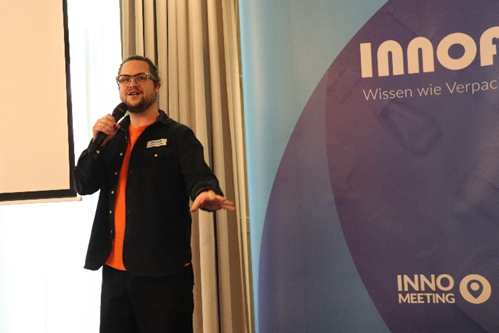
Julian Thielen opened and hosted INNO-Fiber 2026. (Source: pack.consult)
In the opening presentation, Matthias Giebel (Berndt+Partner Consultants) outlined the increasing use of paper as a central trend in flexible packaging. This development is being driven by EU regulatory requirements – such as the Green Deal and the PPWR – as voluntary measures have often proved ineffective. Thanks to improved barrier properties, paper is gaining significant importance in the packaging sector but faces challenges when it comes to recycling. At the same time, a shortage of plastic recyclates and economic uncertainties are putting pressure on the plastics industry. His conclusion: „Paperisation” is a growing but challenging transformation that will gain momentum by 2030 – provided that key conflicting objectives, such as barrier performance versus recyclability, as well as deficiencies in sorting and infrastructure, are resolved.
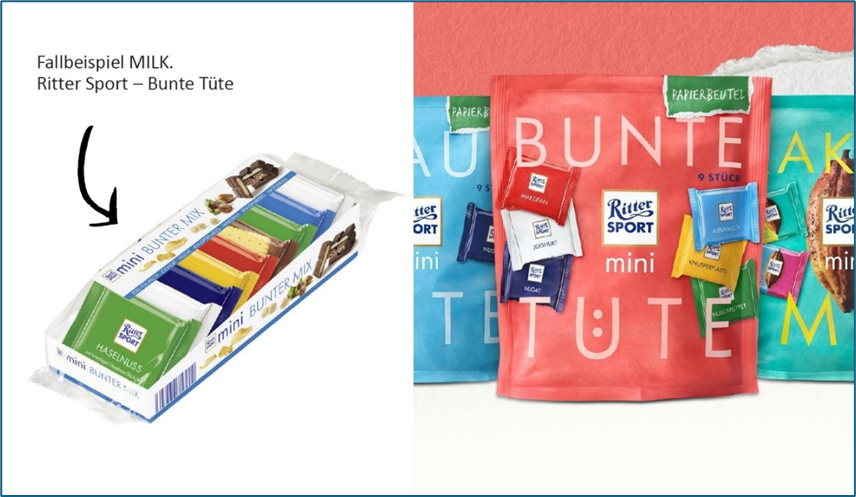
An example of successful design for recycling and successful design for selling. (Source: M.I.L.K. GmbH)
Eleonore Eisath (M.I.L.K. GmbH) highlighted the trend towards fibre-based packaging, which is strongly influenced by regulation and consumers’ emotional beliefs. Although paper is often considered more sustainable, the environmental benefits are not always clear-cut. Consumers often make decisions heuristically, using intuitive approaches, with convenience, function and price taking precedence over sustainability in many cases. Brands find themselves caught between recycling requirements, technical feasibility, and attractive natural design. Successful solutions are likely to come through gradual improvements. Familiar design and transparent communication are key aspects here. Her conclusion: paper should only be used where it functionally appropriate and credible.
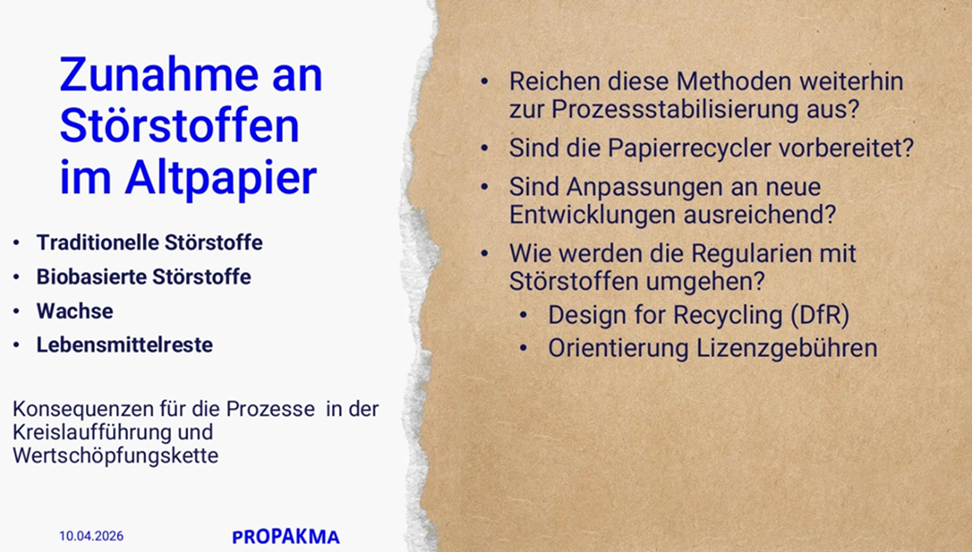
In addition to traditional contaminants, there are now bio-based contaminants, waxes and food residues. (Source: Propakma GmbH)
Dr. Arne Krolle (PROPAKMA GmbH) addressed the regulatory and process-related challenges posed by paper-based composite packaging in the wastepaper recycling loop. The increasing presence of contaminants in the wastepaper cycle from barrier materials, bio-based plastics and food residues undermines existing process strategies and complicates paper production and processing. He called for clear definitions of contamination levels, harmonised measurement methods (e.g. for PFAS and microbial load) and a practical implementation of the PPWR requirements. The relevant foundations are currently being developed in committees and through research. The aim is to define Design4Recycling principles, suitable testing methods, and clear limit values in such a way that recyclability, product safety, and process stability are better aligned within the paper value chain and recycling loops. The upcoming iterative process towards this goal requires joint efforts to achieve a new level of stability in the value chain.
Dr. Tiemo Arndt (Reflex GmbH & Co. KG) presented packaging solutions using densified transparent papers, highlighting them as a high-performance, functional barrier for food packaging. Uncoated and entirely plastic-free, they provide reliable protection against oxygen (<0.5 cm³/m²d), aromas, mineral oils, and fats. At the same time, they score highly for their biodegradability and excellent recyclability. Their performance can be further optimised through targeted modifications – particularly in terms of water vapour barrier properties and heat-sealing capability. As a result, transparent papers offer great potential for use as an innovative and sustainable alternative to plastic packaging.
Alexander Schroeder (Sappi Alfeld GmbH) illustrated the potential of specifically tailored barrier papers as a sustainable alternative to plastic packaging. The requirements include at least equivalent product protection, reliable machine runnability and good recyclability within the wastepaper stream. He emphasised that sustainability is about more than just recyclability and includes resource consumption, CO₂ emissions as well as the demand for energy, water, and land. Using concrete examples, he demonstrated that improved recyclability does not necessarily lead to a better overall environmental balance – particularly when a higher packaging weight increases resource consumption. His conclusion: truly sustainable solutions can only be achieved through a comprehensive approach in line with “Remove, Reduce, Reuse, Recycle.” He also called for a uniform “language” among functional paper manufacturers to strengthen market confidence through clear and consistent messaging.
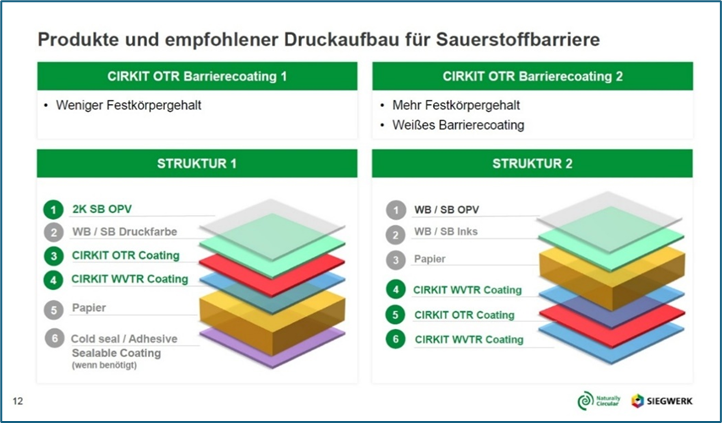
Structural design for an oxygen barrier on paper. (Source: Siegwerk Druckfarben AG & Co. KGaA)
Dr. Flore Mees (Siegwerk Druckfarben AG & Co. KGaA) presented innovative barrier coatings under the name „CIRKIT,” designed to make packaging more sustainable. They offer solutions for replacing multi-material structures with recyclable single-paper solutions. Numerous parameters play a decisive role in successful implementation – including the physical properties of the barrier coating, the paper quality, and the application process. Based on test results, she showed which coating structures specifically improve barrier performance. At the same time, the barrier requirements vary significantly depending on the packaged goods and desired shelf life. Any challenges that may arise during the packaging process can be resolved through close collaboration along the value chain.
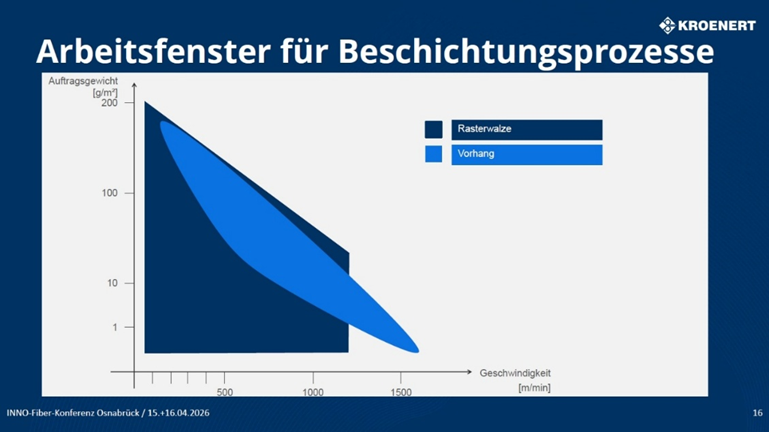
Anilox roller and curtain coating have different application weight and process speed ranges. (Source: Kroenert GmbH & Co KG)
Christian Werner (Kroenert GmbH & Co. KG) highlighted innovative coating solutions for fibre-based packaging that offer high functionality even at minimal coating weights. The range of barrier properties includes resistance to grease and oil, protection against moisture and oxygen as well as resistance to cold, chemicals and UV radiation. Technologies such as anilox roller coating and curtain coating are used, enabling tailored solutions with very thin functional polymers or ultra-thin inorganic layers—even in multi-layer structures. At the Kroenert Technology Centre, various technologies for a wide range of processes are available for testing and development purposes. Closed-loop control systems optimise the coating weight and reduce energy consumption. At the same time, innovative plant concepts such as simultaneous double-sided coating help to significantly reduce costs and CO₂ emissions.
Robin Huesmann (LEIPA Georg Leinfelder GmbH) demonstrated that paper-based composites can lead to sustainable packaging solutions provided that suitable applications are carefully selected and consistently aligned towards circular economy principles. Successful concepts combine functionality, economic viability, and adaptation to market-specific recycling infrastructures. Key prerequisites include the use of sustainable raw materials, reduced material complexity, design for recycling, and the avoidance of contaminants. In the future, the recovery of plastics from rejects – through dry or wet mechanical processing – may also contribute to PPWR compliance of paper/polyolefin composites, although this is still under development. He also presented a technical solution for processing food-contaminated wastepaper from fraction 5.01 for use in corrugated base paper. Overall, paper can economically replace plastic in defined applications, but this requires carefully designed use cases.
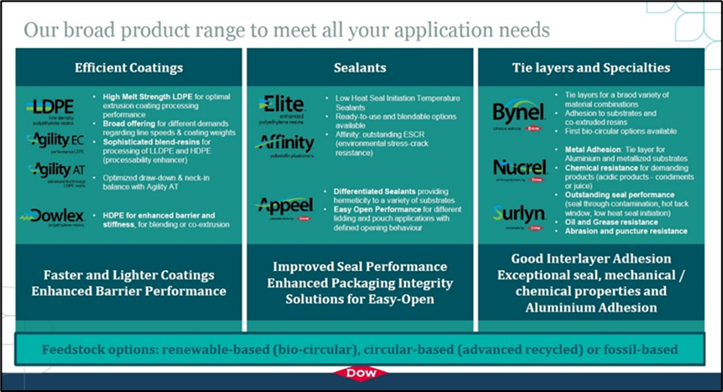
Dow’s product portfolio for extrusion coating and metallisation. (Source: Dow)
In her presentation, Anna Helgert (Dow) examined paper composites for packaging in the context of balancing functionality with PPWR regulatory requirements. The focus was on ‘design for recycling’ approaches, increasing recycled content targets, and technical solutions for demanding barrier applications. She presented development approaches as well as industry-proven innovations based on Dow’s broad portfolio of extrusion coatings and dispersion coatings, which enable the optimisation of barrier performance, sealability and processability. Dow Pack Studios™ provide comprehensive development resources, from laboratory scale through to industrial implementation, supporting the development of recyclable packaging solutions to meet regulatory requirements.
Andreas Bergmeier (Felix Schoeller) compared multi-layer curtain coating, with up to five dispersion layers, to the up to five-layer extrusion coating for flexible, fibre-based packaging. Both technologies provide high barriers against oxygen, grease and mineral oils while maintaining a high paper content. Whilst extrusion coating scores highly with a low coating weight of just 3 g/m², excellent sealing properties, high stability and crease resistance, curtain coating impresses with ultra-thin, homogeneous layers and high processing speeds. Depending on the application, both processes offer clear, future-proof solutions with specific advantages and limitations.
The second day of the event took place at Felix Schoeller’s paper mill, where Guido Hofmeyer welcomed the participants. The family-owned business, deeply rooted in Osnabrück, has been synonymous with specialist paper solutions for decades and is now applying its expertise to the field of flexible packaging papers. A particular highlight was the factory tour, which provided fascinating insights into production processes and practical operations.
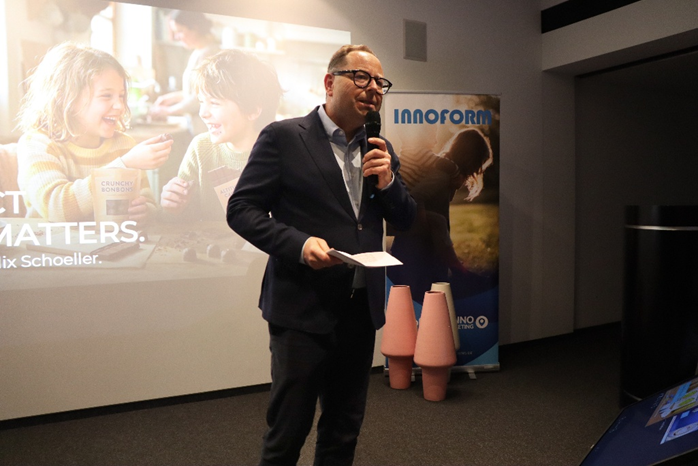
Guido Hofmeyer, Managing Director of Felix Schoeller, welcomed the participants on the second day of the event in Osnabrück. (Source: pack.consult)
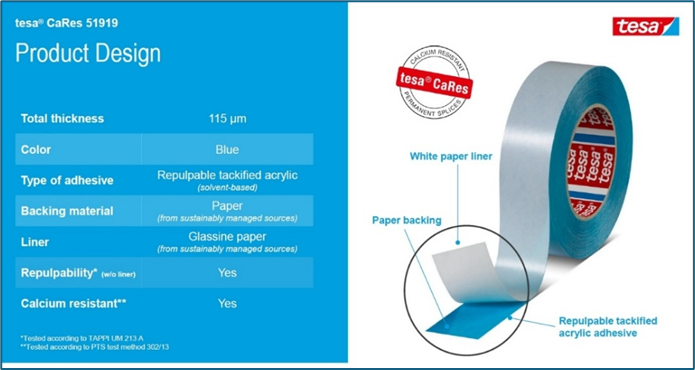
tesa® CaRes 51919 is a repulpable adhesive tape developed for barrier papers (Source: tesa SE)
Johannes Werthan (tesa SE) provided a concise overview of applications in the production and processing of functionally coated papers and their specific requirements. The focus was on repulpable adhesive tape solutions for splicing, which support recyclability and process stability. These are based on a paper backing with a water-soluble acrylate adhesive and must ensure strong adhesion to both coated and uncoated papers, excellent shear strength and resistance to calcium carbonate-containing topcoats. Innovations are aimed at such paper-based alternatives and CO₂ reduction. Close customer collaboration serves to further improve efficiency, quality, and sustainability.
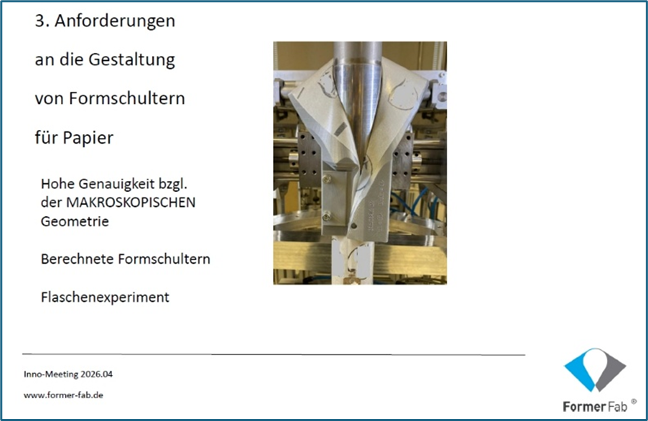
Forming rolls for paper webs require application-specific, custom-designed solutions (Source: FormerFab® GmbH)
Dr. Henry Drut (FormerFab® GmbH) highlighted the need for specially adapted forming shoulders for processing paper webs in packaging machines. Conventional designs intended for plastic films often lead to problems with paper, such as web breaks, unstable running, creasing, and leaks. These problems stem from the material-specific properties of paper; in particular, low elasticity, reduced tear resistance, higher stiffness and increased frictional resistance. This results in clear design requirements: optimised macro- and micro-geometries, gentle deflection paths, as well as wear-resistant and friction-optimised surfaces. For a successful transition, he therefore consistently recommends mould shoulder solutions developed specifically for the application. When designing new packaging machines, sufficient installation space for the mould shoulder should be considered.
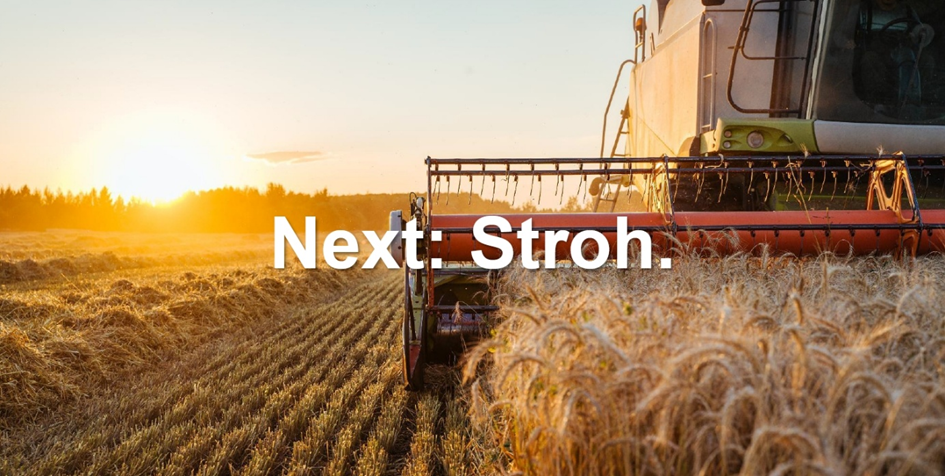
Straw as an alternative raw material for paper-based packaging solutions. (Source: OutNature)
Thomas Strieder (OutNature GmbH) presented straw as a next-generation fibre for innovative paper and packaging solutions. Considering an expected 160% increase in demand for paper packaging by 2045 (source: WWF, Biogenic Raw Materials in Packaging), it offers a scalable alternative. The fibres are based on an agricultural by-product grown in Germany, involve short transport distances and enable cascading use of raw materials. The concept is gaining momentum in the industry: LEIPA plans to produce approximately 35,000 tonnes of paper annually, with a 20% straw fibre content in the waste paper mix, which is fully recyclable. This new development is scheduled for early 2027.
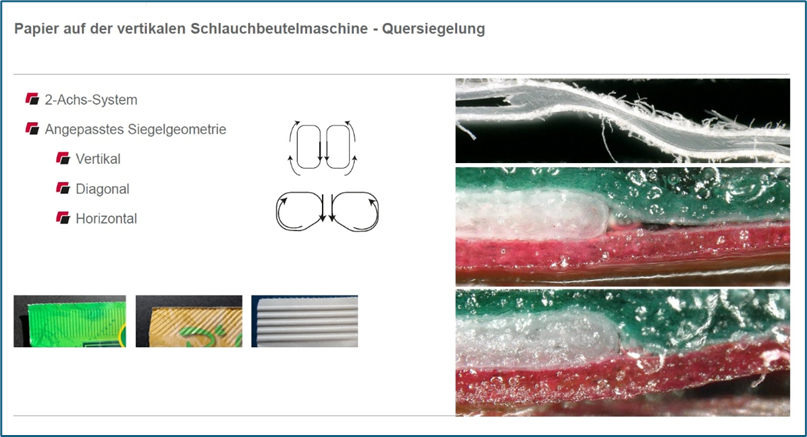
The seal on the cross-seal is not yet airtight in the middle image on the right; only the bottom image shows an airtight seal. (Source: Rovema GmbH)
In her presentation, Dr. Anina Leipold (ROVEMA GmbH) outlined the key factors influencing the processing of paper on vertical form-fill-seal machines – from forming to final packaging. The main challenges lie in adjusting the forming shoulder and forming collar gap, the longitudinal and transverse sealing, and ensuring the chute is correctly positioned. A 2-axis system, servo-driven side folding and a horizontal sealing geometry support the production of gas-tight bags. The key to success lies in precisely matching the forming part geometry to material-specific properties such as paper thickness, friction and forming behaviour.
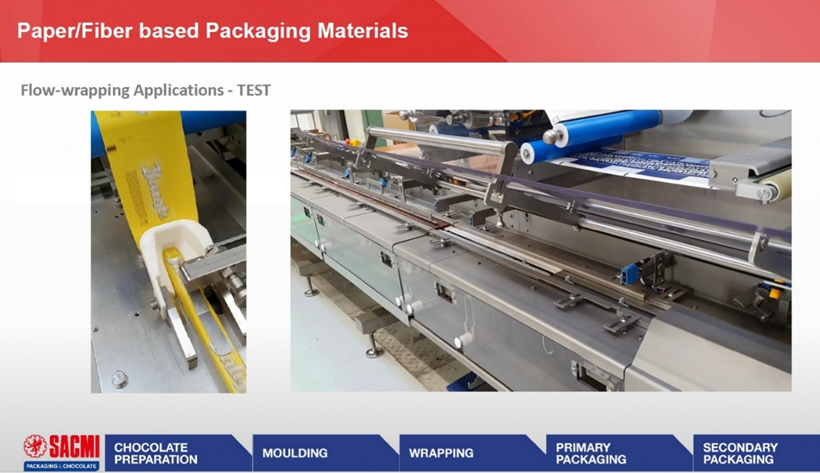
Left: Test shoulder in a flow-wrapping test. (Source: SACMI Packaging & Chocolate Swiss SA)
Herbert Hahnenkamp (SACMI Packaging & Chocolate Swiss SA) spoke about the challenges and solutions involved in switching to fibre-based packaging. The company covers the entire process chain – from chocolate production and moulding systems to secondary packaging, including specialised wrapping machines and flow-pack solutions for paper films. When using paper and board as packaging materials, a structured format development process—from material analysis to final approval—is essential. Challenges include machine compatibility, capacity, and material properties. Stable processes can be achieved through testing, customised moulded parts, and clearly defined quality criteria.
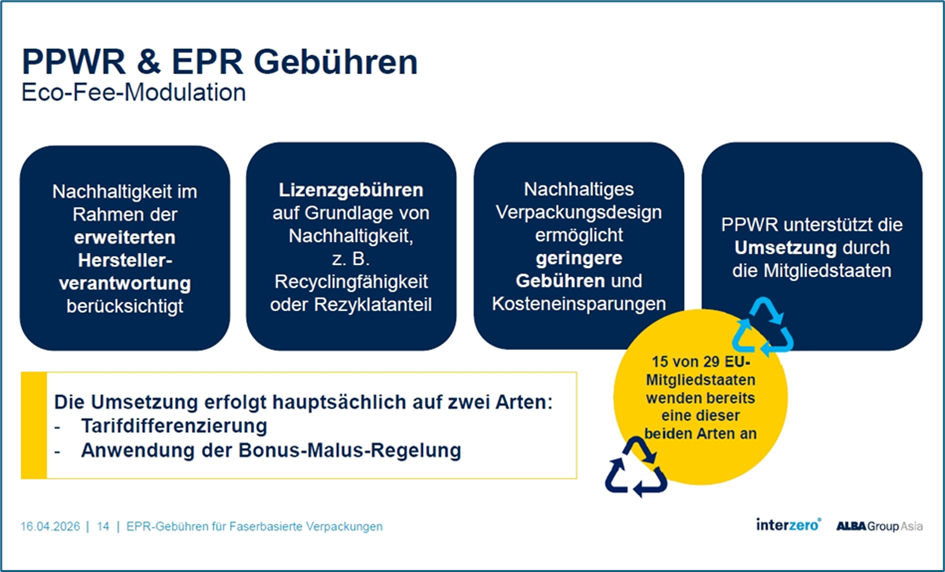
The Eco-Fee is adjusted through tariff differentiation and the application of bonus-malus schemes. (Source: Interzero)
Dominik Lichtenthäler (Interzero Circular Solutions Germany GmbH) explained the structure of EPR (Extended Producer Responsibility) fees and addressed the optimisation of packaging as well as the associated EPR fees in Europe. Licensing fees for the paper material stream are significantly lower in many countries (e.g. Belgium, Austria, Spain) than for plastics or composites, which encourages “paperisation.” Some countries already apply a form of eco-fee modulation, which enables lower fees through sustainable packaging design. Classification as paper varies nationally depending on the fibre content (e.g. ≥ 95% in Germany, ≥ 80% in Austria). Coatings can lead to classification as a composite fraction, which significantly increases the fees.
Julian Thielen concluded „Inno-Fiber” with a concise summary of all the presentations. In its compact format, the symposium impressively demonstrated the potential of functional packaging papers as sustainable packaging solutions and proved its worth with technically sound findings, practical insights and direct exchange between industry development and application. With the successful launch of „Inno-Fiber,” Innoform Coaching GmbH has created a platform that actively supports the transformation process of the packaging industry and provides impetus for future developments. It met expectations and will become an integral part of the industry calendar.
Next Events

24. Inno-Meeting – Flexpack-Kreisläufe, die sich rechnen
Tuesday, 16 / Wednesday, 17 February 2027 – Start 9:00
Add to calendar: Google · Outlook · Calendar file


Faserbasierte Verpackungen
Tuesday, 20 / Wednesday, 21 April 2027 – Start 9:30
Add to calendar: Google · Outlook · Calendar file