
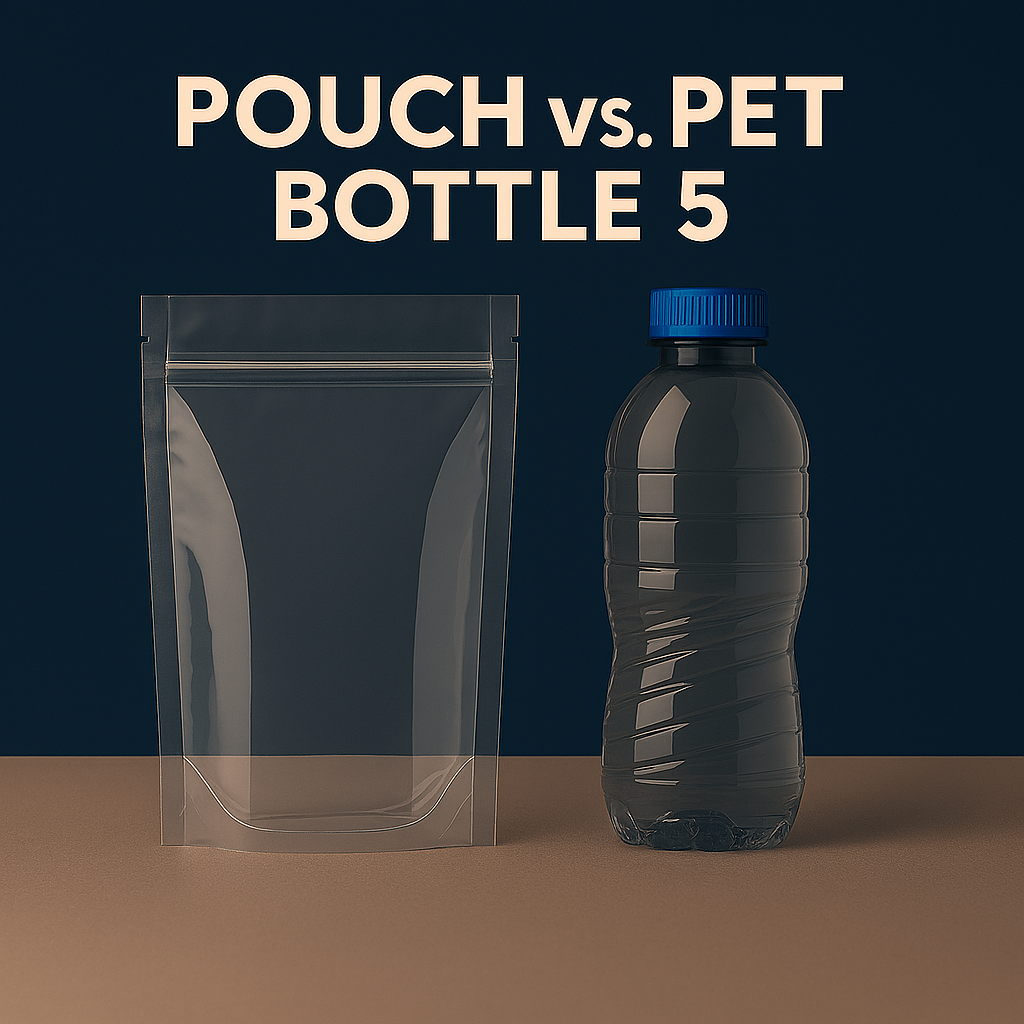
PP stand-up pouches vs. PET bottles for high-quality and sensitive fillings – a report by Dr. Bernd Knierbein
As by January 2026, part 5 from 5, part 4 here:
5. Applications, recycling aspects and conclusion
5.1. Use and application
5.1.1. Pouches
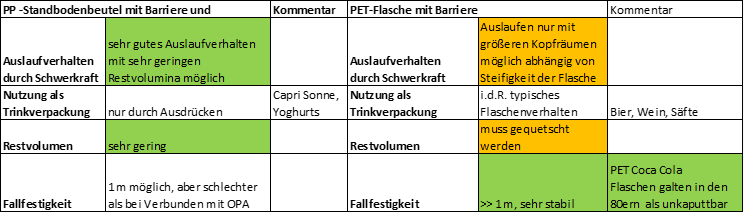
As a form of flexible packaging, pouches offer further application options compared to semi-rigid or rigid bottles. With the appropriate pouch design, the liquid product can be dispensed solely by gravity and without aeration, leaving minimal residual volumes and without the need for significant headspace.
A drop resistance of around 1 m is possible for stand-up pouches made of polyolefins, but this is inferior to that of previous composite materials containing oPA and also inferior to that of PET bottles.
5.1.2. Bottles
With the right bottle design, gravity-fed dispensing is only possible if the headspace is significantly larger than in pouches.
The most common use of PET bottles is for packaging liquids only, as they typically exhibit standard bottle behaviour:
- Beer
- Wine, juices
- Ketchup
- Sauces
The drop resistance is well over 1 metre; Coca-Cola’s PET bottles were considered unbreakable in the 1980s.
Without ventilation, the bottle has poorer passive leak resistance than the pouch. With sensitive contents, unfiltered ventilation can lead to contamination of the product.
Table for chapter 5.1: Use and Application
5.2. Recycling
5.2.1. Pouches
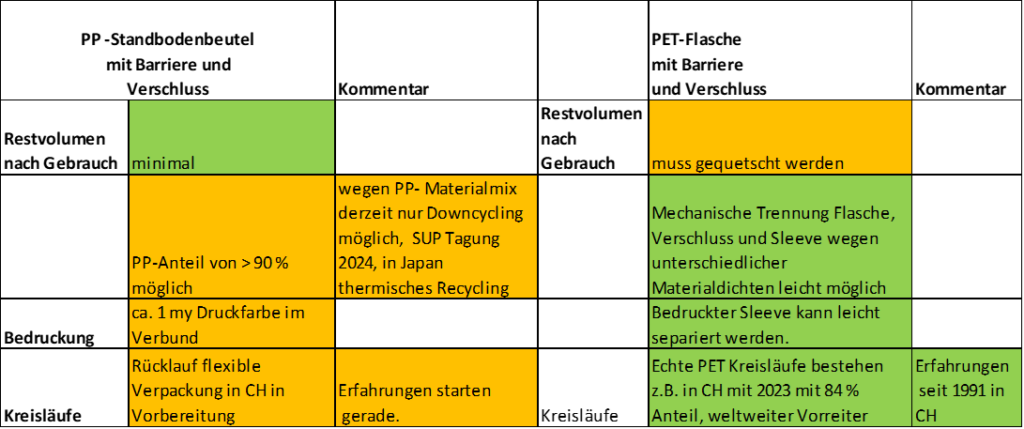
The residual volume of the pouch is minimal due to the films folding in on themselves after use. With the latest developments, PP content of over 90 % is achievable, which formally certifies recyclability.
In practice, however, only downcycling usually takes place, as composite structures and printing make economic recycling difficult.
In Japan, a pioneer in flexible packaging, thermal recycling is permitted /30/.
To make matters worse, in the case of sterilisable composites, the printing is applied as a reverse print using approximately 1 m of ink.
5.2.2. Bottles
To reduce the residual volume, the bottles must be crushed.
The mechanical separation of the bottle, cap and sleeve is easily achievable due to the different material densities.
The printed sleeve, which is therefore contaminated, can thus be easily separated.
Table for chapter 5.2: Recycling aspects
5.3. Cycles in Switzerland
The practical aspects of recycling are examined below, with a particular focus on Switzerland, which is of interest for the following reasons:
- High-end market
- Innovative
- Centrally located in Europe with a variety of language groups, i.e. highly representative of Europe
In Switzerland, the following distinctions are made regarding the return of packaging:
- PETRecycling.ch /31/:
Pure PET packaging, established in 1991
- RecyBag.ch /32/:
Other plastic packaging and beverage cartons, launch from 2025
In 2023, Switzerland will have a 84 % rate of genuine PET recycling, making the country a global pioneer in this field. An advance recycling levy (vRB) is charged on PET beverage bottles, which is included in the purchase price.
The RecyBag is available for purchase in sizes ranging from 17 litres to 110 litres. Consumers are thus ‘encouraged’ to use packaging materials sparingly.
5.4. Comparison of PP stand-up pouches and PET bottles
Once both types of packaging have been analysed, their key strengths and weaknesses become clearer.
Advantages of stand-up pouches:
- Weight advantage: Weighing approx. 10 – 12 g for 500 ml, the pouch is usually lighter than the bottle and saves on transport resources
- Residual emptying: Excellent flow properties without aeration, minimal residual volume
- Flexibility: Also suitable for chunky products thanks to filling via the top opening and sterilisation
- Logistics of empty packs without spouts: Can be transported flat to save space
Disadvantages of stand-up pouches:
- Complex manufacturing processes with high start-up and cutting losses
- Higher risk due to micro-leaks in the multiple weld seams
- Complex autoclave sterilisation requiring significant amounts of energy, media and space
- Recycling not yet fully resolved; mostly downcycling
- Lower output in the welding and filling stages compared to bottle production
Advantages of PET bottles:
- Highly efficient production: Few steps, very high output thanks to optimised injection moulding and stretch blow moulding processes
- Process reliability for demanding products: Established aseptic filling, fast and reliable processes
- Robustness: High impact resistance, simple logistics, low risk of leaks
- Recycling: Long-established systems with high return rates (e. g. 84 % in Switzerland)
Disadvantages of PET bottles:
- Higher residual volume after use
- Poorer passive pouring performance without aeration
The PET bottle is now the more robust, better-established standard, offering high efficiency and recyclability.
The stand-up pouch is advantageous when weight, ease of pouring and the ability to empty the contents completely are key factors.
The future lies
- in more advanced filling systems and cost-effective recycling solutions for flexible packaging
- and in further material savings for PET bottles.
Sources:
/30/ Glatz: Pouches in the drugstore section
8th European Stand-up Pouch Conference, 6 und 7 November 2024
/31/ https://petrecycling.ch/
/32/ https://recybag.ch
