Matthias Giebel’s analyses show a demonstrable increase in paper packaging, with further growth potential through 2030. Alongside consumer preferences, regulatory developments, particularly the PPWR, play a central role. This creates additional incentives in favor of paper-based solutions when compared to plastics.
At the same time, it became clear: paper is not a sure thing either. While it benefits from a well-established recycling infrastructure, it also faces challenges – particularly regarding the actual recyclability of complex applications. Plastics, on the other hand, struggle primarily with inconsistent infrastructure across Europe. This is precisely where a competition for innovation is emerging, in which the paper side is currently particularly active.
Applications: Out of the Niche – But Not Without Limitations
A key finding from the analysis: paper packaging can now be found in almost all sectors. Market launches are particularly strong in confectionery, which recently accounted for around 30% of paper-based new products. There are also initial attempts in more sensitive areas such as frozen food applications – whether these will prove successful in the long term remains to be seen.
However, limitations also became apparent, particularly with chocolate: issues such as puncture resistance (e.g., with nuts or cereals) and product residues that can interfere with paper recycling show that not every application is trivial to convert. Dry foods such as rice, pasta, or many muesli products are considerably easier. Here, paper-based solutions can be implemented with relatively little effort – sometimes even with additional functional benefits.
“We now see paper packaging in almost all sectors – out of the niche, but not without compromises.”
Matthias Giebel, INNO‑Fiber 2026
Barriers: Cost, Machine Compatibility, and Uncertainty
The presentation identified three factors as the biggest obstacles to broader implementation: cost, machine compatibility, and regulatory uncertainty. While cost is often the short-term argument, converting existing filling and packaging lines represents a medium-term strategic task – similar to the earlier switch from multilayer to monolayer plastics.
In the long term, instruments such as eco-modulation could have an influence, although their implementation at the European level is inconsistent. Individual national solutions are currently creating additional complexity and uncertainty. The appeal to brand owners and packaging companies: don’t just calculate short-term, but plan according to clear criteria.
Three Key Levers
From Matthias Giebel’s perspective, companies should consistently align their decisions with three core themes:
- Recyclability
- Recycling infrastructure
- Recyclate use in plastics
Costs would – according to his assessment – be subordinate to these requirements in the long term, as it ultimately comes down to compliance and not voluntary individual measures.
More Dialogue Instead of Individual Tests
Another central topic was communication along the value chain. While brand owners are largely convinced of a preference for paper through the PPWR, this conviction already decreases among converters – not least due to cost pressure. This leads to projects being stopped at the last minute despite successful development.
The recommendation: move into practical trials earlier, gain experience, and gradually convert product lines instead of getting stuck in endless test loops. At the same time, more openness is needed in dialogue – between brands, packaging manufacturers, and other actors in the chain.
Conclusion: Paperization Is Real – But Not an End in Itself
The opening presentation made it clear: paperization is not a hype, but a relevant development path. However, it will only be successful where technical feasibility, regulatory requirements, and economic realities are considered together. The discussion at INNO‑Fiber 2026 provided a solid foundation for this.
Transcript
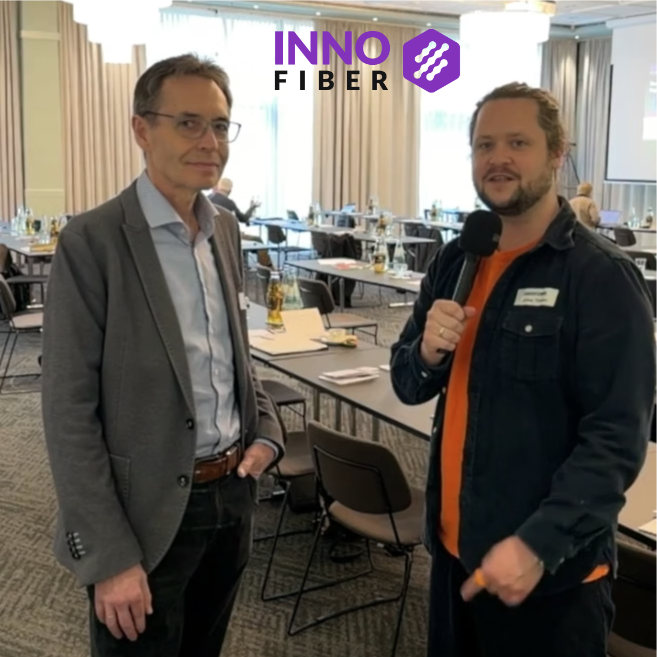
Alright. We now have Matthias Giebel with us. He gave us the opening presentation today and from a high-level perspective, from various angles, also with a survey, first questioned paperization as a trend, but then showed that we are right in the middle of this trend. What were your key learnings from it?
First of all, as you already said: we can demonstrably say that we have a significant increase in paper packaging and with regard to the outlook toward 2030, further growth is also expected based on the survey. We actually believe that in addition to consumer preferences, which were covered in another presentation, regulatory aspects also play a major role.
And we see that the PPWR, particularly in the comparison between paper and plastics, shows certain preferences toward paper. However, paper also still has issues with recyclability, while on the other hand it has good recycling infrastructure. Plastics themselves have problems with recycling infrastructure when we take a Europe-wide perspective. We believe an exciting competition for innovation is currently taking place, in which the paper side is significantly more active at the moment.
You also showed that market launches of paper-based packaging are particularly strong in confectionery right now. I believe 30% of all launches were in this area. Will this continue to increase there? Or do you perhaps also see sectors that will now catch up strongly? Do you have a small forecast for the future? Yes, first of all, we actually systematically evaluated this over three years and our first finding is that we actually already see it in every sector.
That means we even see initial applications in the frozen food area. Whether they make sense and will establish themselves in the long term… So in that sense, it’s out of the actual niche. Nevertheless, we naturally have top application areas and I actually believe that with chocolate, people started relatively early. But they also found in individual cases that it’s not quite so easy in terms of puncture resistance when you have nuts in there or cornflakes.
These issues are now well known. Also, that residues actually remain in chocolate packaging and then interfere with recycling. That’s also an issue. There are naturally less critical areas, dry foods, rice, pasta, even most mueslis. There’s still surprisingly much that can be converted with relatively little effort.
You could even, if you then apply a proper mineral oil barrier, which many classic plastic packaging in this area also don’t have because they use polyolefins, have an add-on. However, we also know from individual interviews that product visibility is then naturally important to some brand owners, and there you would have to work with windows again, then you’re back into plastic, then you have reduced recyclability again.
So you notice there are still fields, you have to make compromises. But we see an increasing willingness to do so and the entire hygiene sector also offers huge fields. And those are the low-hanging fruits for now, I’d say. And where do you see the biggest obstacles? Is it the cost of paper, which can be higher primarily due to the higher mass or weight alone? Is it the performance on the machine?
Regulatory Uncertainties in Plastic Conversion
Is it the regulatory uncertainties that still exist? You also pointed that out. What is currently the biggest hindrance? The cost issue is naturally always the short-term argument. Machine compatibility is actually a longer medium-term argument, because you naturally can’t convert every plastic packaging line to paper with the first attempts, there will be presentations on this as well. You have to deal with that in the longer term.
But you also have to do that when you go from multilayer to monolayer plastics. That’s why I say this conversion has always existed in the past. The costs will, I believe, play a role through eco-modulation, if it ever takes effect, hopefully. We’ve already discussed this topic in another context. There’s naturally still high complexity in it and then it says countries can influence through eco-modulation. It doesn’t say they must.
Individual countries are already doing it, which is currently causing great confusion. So I believe it’s a mix of factors. That’s why we always tell brand owners or packaging companies in conversations to think long-term based on these criteria – recyclability, recycling infrastructure, recyclate use in plastics. Those are the three levers. And the costs will align with these, because ultimately everyone has to do it. We’re talking about compliance.
Exactly, we actually have more presentations on this. We’ll look at how licensing costs compare. The fortunate thing in that sense is that we’re not even talking about eco-modulation here, but we always already have tariffs for pure paper and pure plastics. When you talk to brands now, but also to many packaging manufacturers, do you find that they talk a lot with each other or more about each other? Or where is communication perhaps lacking in the chain?
Especially when we address recyclability, we see that we don’t yet have much experience with what works in the stream and what doesn’t. How does the paper-side chain function? Well, basically a chain always works on pull and not on push.
And therefore, from logic, it should follow that if our survey showed that brand owners are most strongly convinced that the PPWR, which ultimately prefers paper, thus favors and thereby promotes it, then they should actually motivate their value chain to participate. However, we notice at the next level that converters no longer have this conviction.
Apparently cost pressure already comes back into play to some extent. And that’s why we also believe that all these developments, I also know of individual projects now in the context of these interviews, where the development was actually already complete for a conversion toward paper and then at the last moment they decided against it for cost reasons. That’s naturally a bad message at this point, also to the market, because that naturally spreads.
That’s frustrating. Some already argue that the transition periods are simply too long until 2030, that things should have been required earlier. That’s naturally always easy to say in hindsight, but I believe more dialogue is always good. And what I would always prefer is to get into trials quickly and after the trials then convert individual product lines.
Production Conversion to Paper: Risks
Because we’re currently in a situation where you have the feeling that everyone tests once, also tests in production, in filling, and then first says: “Now I know it works and now I’ll lean back for the moment, because we’re in a crisis right now.” But I also understand the counter-arguments to some extent.
Original quote: “Well, if I now convert one line, one product line to paper, the Deutsche Umwelthilfe will be at my door the next day and say: ‘Why and why not the others too?’” So everything you do there must naturally also be well thought out. In that sense, I understand it’s a certain dilemma and with the crisis argument, I can naturally justify any delay for now. And it’s not entirely unjustified, you have to say that.
No, we also see great caution with these conversion measures. But the discussion is already going very well here this morning. You provided the foundation for it with your first presentation and many thanks again for that. Yes, thanks for the invitation. Gladly. It was a pleasure to speak with you. Great, thank you very much. Good luck. Okay, strong.
