
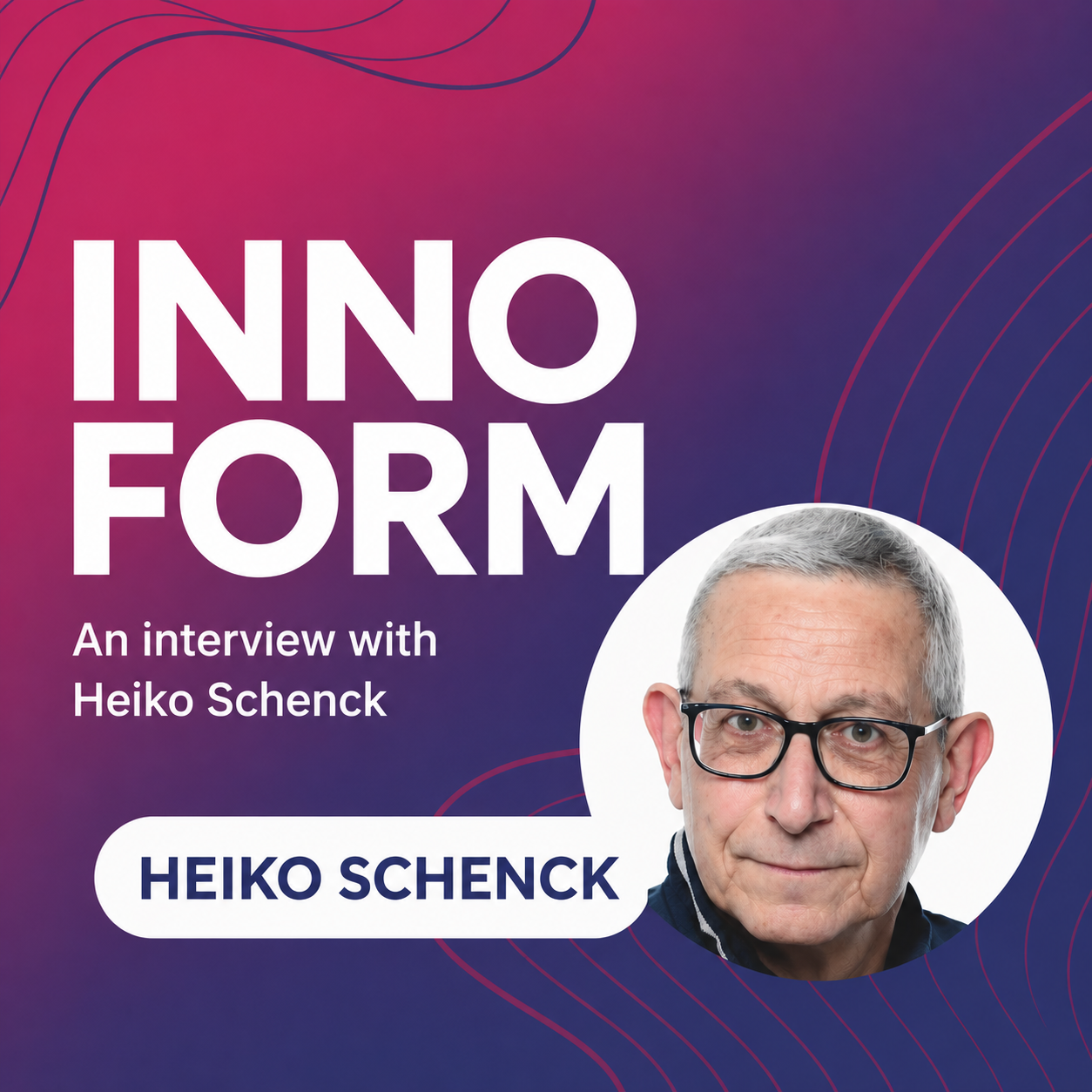
Reinventing the flexpack industry
A conversation with Heiko Schenk about technology, sustainability, and market shifts.
Die flexible Verpackungsindustrie befindet sich in einem tiefgreifenden Wandel. Nachhaltigkeitsanforderungen, volatile Rohstoffmärkte und enorme technologische Fortschritte verändern gleichermaßen Materialien, Prozesse und Machtverhältnisse entlang der Wertschöpfungskette.
In a recent Innoform interview, Julian Thielen spoke with Heiko Schenk—polymer chemist, long-standing industry expert, and consultant—about these precise changes, covering everything from modern extrusion technology and orientation processes to the current role of recycled materials.
From polymer chemist to strategic consultant
Heiko Schenk has more than three decades of industry experience. After joining DuPont in the late 1980s, he worked there until the merger with Dow – with a clear focus on polymers, adhesion promoters, peel solutions and technical applications.
The common thread throughout his career is defined by:
- in-depth expertise in materials and processes,
- Project management across global value chains (including work with consumer goods companies such as Unilever and Kraft),
- close collaboration with leading extrusion machine manufacturers.
He has been running his own consultancy since 2022. His work is now based on three pillars:
investment advice for extrusion systems, international project management, and training – particularly in-house – tailored to specific companies and applications. It is precisely these in-house formats that allow for a level of openness that is often not achievable in mixed training groups.
Extrusion today: much more than just blown film
For a long time, extrusion was largely equated with blown film. But that view no longer holds true today. Alongside blown and cast films, orientation technologies are playing an increasingly central role.
Heiko Schenk identifies three relevant procedures:
- Tenterframe process (traditional, e.g. Bruckner),
- MDO (Machine Direction Orientation), now available inline for both blown and cast films,
- Triple-Bubble, which is already in successful use outside the German-speaking world, with several hundred systems installed.
It is precisely these processes that open up new ways of selectively orienting polyethylene films – a fundamental prerequisite for high-performance single-material solutions.
Sustainability: Déjà vu under new circumstances
The current debate on sustainability strongly reminds Heiko Schenk of the early 1990s: back then, also, plastic packaging was seen as a problem, and public pressure was intense.
The difference compared to today:
- The regulation applies across Europe and worldwide,
- the investment volumes are significantly higher,
- the technological tools are considerably more powerful.
However, one well-established principle has been confirmed:
Reducing weight works.
Over the decades, films have become consistently thinner – whilst delivering better performance. Stretch films are a striking example of this: today, they require less than a third of the amount of material used in the past.
At the same time, flexible plastics began to replace glass and metal – for example, with the rise of stand-up pouches.
New power dynamics in the value chain
One change that is often underestimated concerns the decision-making structures in the market. These days, demands no longer come primarily from brand owners, but increasingly from the retail sector.
Major retail groups such as the Schwarz Group (Lidl, Kaufland) now have their own packaging expertise – a marked difference from 30 years ago. This has a significant influence on the choice of materials, recyclability and design decisions.
Orientation of polyethylene: the key to monomaterials
One of the technological breakthroughs of recent years has been the orientation of polyethylene films. Since K 2019, it has become clear that:
Using suitable processes, it is now possible to produce PE monomaterials that come close to matching traditional composites in many applications.
Examples:
- MDO as a substitute for PET outer layers,
- Tenterframe and triple-bubble processes for higher densities,
- Weight reductions of up to 40% for cover films – without any loss of performance.
Triple Bubble also allows for precise control of shrinkage behaviour – from high shrinkage rates down to virtually zero, for example for applications in electric mobility.
Recycled materials: technologically feasible, economically challenging
Post-consumer recycled materials (PCR) are nothing new. They have been used successfully in transport packaging for years – particularly in the middle layers of modern multilayer films.
The technological advantage today:
- reliable recipes from raw material and machinery manufacturers,
- consistent quality,
- hardly any in-house development work is required.
However, the economic reality remains complex:
High quality means higher prices, whilst cheaper recycled materials lead to greater price fluctuations. Success comes to those who approach technology and business as a single entity and use materials strategically where tolerances allow.
The raw materials crisis as a catalyst for recycling
Geopolitical tensions and production disruptions in the Middle East led to massive price rises in 2026 – affecting both virgin materials and recycled materials.
Historical parallels (e.g. the ‘Uri’ winter storm of 2021) show that:
Such crises have a long-term impact and often drive prices up for years.Historical parallels (e.g. the ‘Uri’ winter storm of 2021) show that:
Such crises have a long-term impact and often drive prices up for years.
The recycling sector is currently experiencing a period of exceptional growth: investment is finally on the rise again. At the same time, Heiko Schenk warns:
Without reliable political and economic conditions, Europe risks losing further recycling capacity – whilst countries such as China are strategically focusing on the circular economy and renewable energy.
A quick overview: hype or the future?
To conclude the interview, Heiko Schenk explains the key terms:
- Paper packaging: is set to increase – but this will depend on the application
- Bioplastics: currently of little practical use without a recycling stream
- Chemical recycling: essential for food applications
- AI in film production: already a reality, and continuing to grow
- Yellow bag: a successful model that works
- Made in China: a leader in polymers – Europe remains strong in machinery and recycling technologies, but is under threat
Fazit
The flexpack industry is not facing its demise, but rather a realignment.
Technologically, many solutions are available – from oriented PE films to the intelligent use of recycled materials. The key will be to bring together investment, regulation and technological expertise.
Or, as becomes clear in the discussion:
What is needed is not panic, but a level-headed, fact-based approach – and the courage to make more consistent use of existing technologies.
more info:
