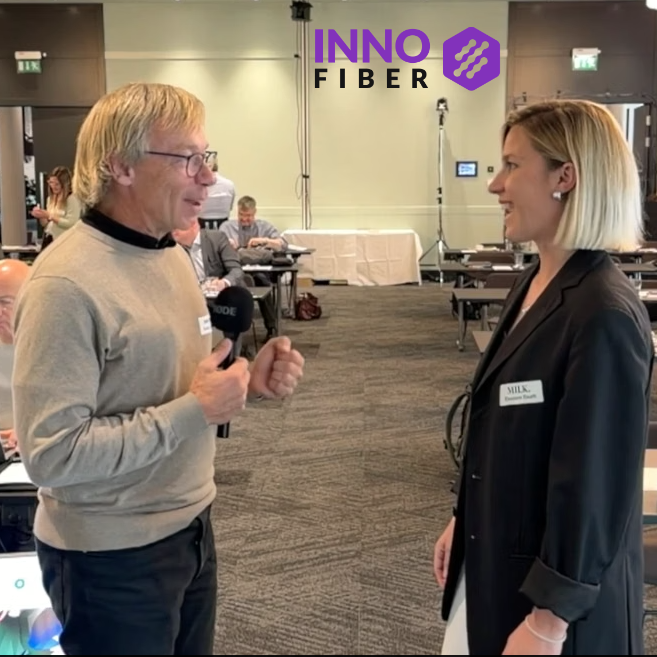
At INNO‑Fiber 2026 in Osnabrück, Eleonore Eisath (MILK.) spoke about a central tension in packaging development: the conflict of objectives between consumer expectations, brand logic, and regulatory-technical requirements. In her presentation, she demonstrated why supposedly simple solutions – such as a blanket switch to paper – do not do justice to the complexity of modern packaging systems.
Brands are under dual pressure
From the brand perspective, packaging decisions today operate within a narrow corridor. On one hand, consumers expect intuitive, familiar solutions that fit the brand. On the other hand, requirements from regulation, recyclability, and technological limitations are constantly increasing.
Eleonore Eisath clearly articulated this conflict of objectives: packaging must both convey brand values and fulfill real functional and regulatory requirements. One aspect that is often underestimated is the depth of so-called design codes – those visual and tactile characteristics that consumers unconsciously associate with a brand. These cannot be arbitrarily changed without risking acceptance.
Selling yes – but differently than before
While packaging was previously understood primarily as a sales enhancer, the focus has shifted. It is no longer about “selling more at any price,” but about meaningful, credible selling that brings together brand, product, and responsibility.
Particularly in the area of fiber-based packaging, it becomes evident how demanding this transformation is. Many consumers reflexively consider paper more sustainable than plastic. However, this equation is not tenable from a technical and ecological perspective. When paper is used where it makes no functional sense, a gap emerges between expectation and reality – and this is increasingly perceived critically by consumers.
Paper is not inherently the better solution
A central theme of the presentation was therefore the differentiated use of materials. Paper can be meaningful and effective in many applications, but is not universally applicable. Examples such as so-called paper bottles show that “paper aesthetics” without functional added value can even create irritation.
Eleonore Eisath advocated for using materials where they make sense technically, ecologically, and from a brand perspective – and taking consumers transparently on this journey. However, without overloading them: communication must remain understandable and must not disappoint expectations.
“Papers are meaningful and great in many areas, but there are still applications where plastics or glass are technically the better solution.”
Eleonore Eisath, MILK., INNO‑Fiber 2026
Conclusion: Honesty beats simplification
The presentation made clear: sustainable packaging is not solely a question of materials. It emerges from the interplay of function, brand, regulation, and consumer understanding. Blanket answers fall short – what is needed are comprehensible decisions and honest communication about limitations and possibilities.
However, this also presents an opportunity for brands: those who credibly explain why packaging is designed the way it is strengthen trust – and ultimately their own positioning.
Transcript
I’m speaking with Eleonore Eisath. We’ve recorded a podcast together before. Now you’re here live. That was wonderful and you opened up a big topic in your presentation. What was it about? Can you briefly outline what you discussed? Yes, of course. It was basically about how brands respond to the current situation and what conflict of objectives they find themselves in.
As a brand, it’s always about – on one side you have to meet consumer demands and on the other side you have all the regulation, all the technical challenges of recyclability. And my presentation was about how you can find the best compromise. You’re a packaging agency. I always say advertising agency. In the past it was about selling more. That’s no longer the case today. Where is the focus today?
Especially when we talk about fiber-based materials – is it really still about selling more, always more of the same? No, it hasn’t been about that for a long time, but it’s still about selling, of course. Not about selling more, but about selling well, selling meaningfully and also about strengthening and positioning the brand accordingly.
And I think that’s something many paper manufacturers initially struggle with – this brand logic that they primarily have to fulfill what the consumer imagines and that these design codes that consumers associate with the brand are so deeply ingrained in people. You also showed this conflict of objectives. Consumers inherently find paper more sustainable than plastic, for example.
That doesn’t work for purely technical reasons and consumers also punish it. So if they feel that the paper doesn’t make sense here, as with paper bottles for example, then it’s actually a disturbing feeling for the consumer. Papers are meaningful and great in many areas, but there are of course also areas where it’s technically much more sensible to use plastics or glass. And I think we should take consumers on this journey.
Of course, you can’t expect too much from them, but use papers where it really makes sense. Says Eleonore Eisath at Inno-Fiber 2026 in Osnabrück. Thank you. Thank you very much.
