
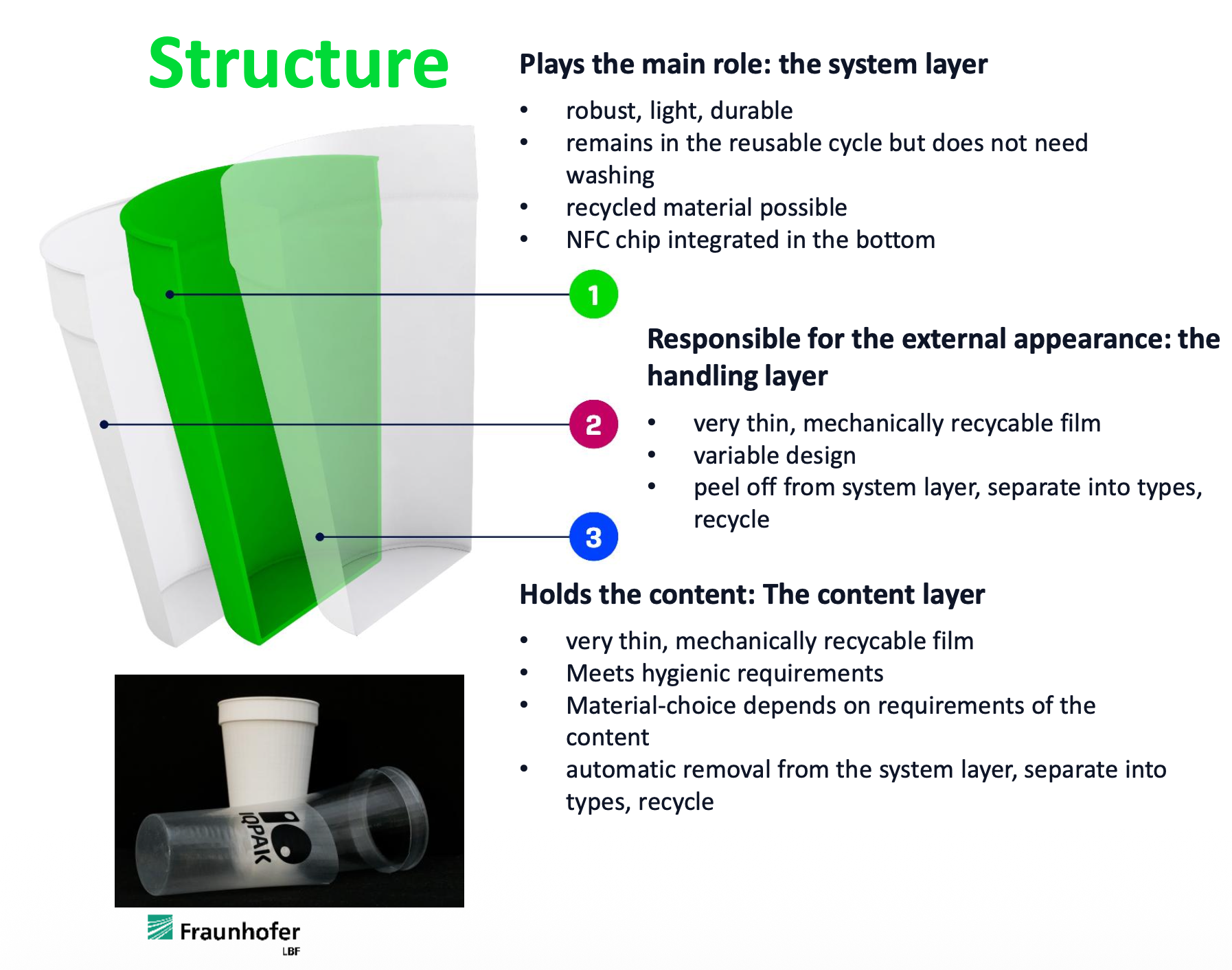
IQ Pak: Separation of system components and hygiene functions
The core of the concept presented consists of consistently separating the ‘reusable component’ – i.e. the durable system carrier – from the functional layers that come into contact with the product and the consumer.
Put simply, the packaging consists of several layers:
Systemlayer:
- Robust, durable structure
- Forms the actual reusable ‘framework’ (e.g. cup or tray)
Contentlayer:
- Layers that interact directly with the filling material (e.g. barriers, sealing media)
Handlinglayer:
- Outer layer that the consumer comes into contact with
- Conveys feel, look and brand image
- Can be applied using thermoforming or sleeves, for example
The key point: the reusable component remains protected from the inside and outside by the hygiene layers. Contamination, product adhesion or visual wear mainly affect the replaceable layers – not the durable system layer.
Less washing, more cycles
Because the system layer is shielded by a hygiene layer, traditional intensive washing processes can often be dispensed with or significantly reduced. Instead, after return, the thin functional layers are removed and sorted by type.
Advantages of this approach:
- Reduced water, energy and chemical consumption
- Less mechanical stress on reusable components
- Longer service life of the system layer and thus more cycles per unit
- More flexible transition to new designs, decors or regulatory requirements
Separating the system and function layers allows the reusable pool to be kept small, standardised and efficient – while at the same time allowing the brand, decor or product-specific properties to be reconfigured in each processing cycle.
Digital traceability via NFC
Another component of the IQPak system is the digital registration of each individual package.
- Each unit is equipped with an NFC chip.
- The chip links the physical packaging to a data record in the central database.
- This data record can be used to display the following information, among other things:
- Number of cycles
- Status in the cycle (in use, in return, in processing)
- Assignment to specific customers, pool operators or applications
- Recycling paths and sorting information for the removed layers
This results in several added benefits for pool system operators:
- Greater transparency regarding stocks and circulation figures
- Better control of logistics and returns
- Sound data basis for life cycle assessments and reporting
Design freedom despite standardisation
A potential conflict of objectives in reusable systems is the tension between standardisation and brand identity: the more uniform the shapes, the more efficient the logistics – the more individual the design, the more a brand can differentiate itself.
IQPak attempts to resolve precisely this tension:
- The system layer remains largely standardised in terms of shape and basic geometry.
- The handling layer and the outer functional layers offer a wide range of design options: colours, printed images, haptics, brand claims.
- These outer layers can be re-selected for each preparation – without enlarging the pool itself.
This combines standardised reusable carriers with individual branding.
Fields of application: from food to non-food
In the transcript, the system is demonstrated using the example of a cup, which is particularly suitable for food and beverages. However, the approach can essentially be applied to various geometries and filling materials – whenever:
- high hygiene requirements apply,
- many cycles are economically viable, and
- a standardisable reusable carrier is to be combined with changing requirements.
Conclusion. Reusable packaging taken to the next level – technically and digitally
The IQ Pak concept shows how classic reusable systems can be further developed with the help of layer construction and digitalisation:
- The system layer is consistently protected, thereby maximising its service life.
- The hygiene layer and handling layer take on the ‘consumption-intensive’ functions – including design, product protection and consumer communication.
- Digital identification via NFC opens up new possibilities for cycle control, reporting and recycling quality.
For companies that want to make reusable strategies sustainable in line with economic and regulatory requirements, it is worth taking a look at such modular, data-based systems. In our formats at Innoform Coaching, we accompany these developments and discuss them with experts.
Transkript
Then we always have a cycle that is represented accordingly. We have, um, um, the filling of a reusable packaging, the use of a reusable packaging. Then, so to speak, the reusable packaging is returned. It is inspected, either sorted out, goes into recycling or is typically cleaned through washing processes and, um, returns to this cycle.
The key to achieving cost effectiveness, meaning economic efficiency on one hand, and high ecological efficiency on the other, is that the packaging must be kept in the cycle as often as possible. And ideally, only a very small pool is needed for this. That means a small pool, high circulation cycles, high economic and ecological, um, efficiency here, so to speak, the classic approach is shown. And at which point might the approach, um, with regard to IQ*Pak deviate?
Somewhat, um, at this point, and you can see this affects many points, although the top point can be removed. Um, the current reusable packaging is of course flexible for different contents. The difference here is if we previously looked at the usage phase, there is naturally some form of mechanical impact on the reusable packaging. There’s an impact from the filling material on the reusable packaging.
In the case of IQ*Pak, the reusable component is protected, so to speak, by thin plastic films so that this reusable component is accordingly protected by the hygiene layer. Another point is that, um, now I’m jumping to the left side here. A traditional washing process can be omitted with IQ*Pak because these hygiene layers, which enclose this system layer, can be automatically removed and reapplied.
And a third point that I would like to highlight here is that, um, each individual package is stored in a database. Um, it can be read via an NFC chip, so to speak. Uh, the status can, um, be read, which brings various advantages, uh, both in terms of, uh, return logistics, but also in terms of the logistics of, uh, the pool system and also in terms of recycling. Um, which I will then go into a bit more detail on, uh, in the following slides.
Let’s take a look at the structure of the IQ*Pak packaging system, even though it is shown here in the form of a cup. The next slide will present examples of other geometries. This structural illustration is meant to help better understand the basic idea of IQ*Pak. Looking here, uh, on the left side of the presentation slide, you can see, uh, this green core. That means this is the so-called system layer, which naturally brings a certain robustness. This is the part that is also kept in circulation.
It amounts to approximately 90 to 95%. In this system layer, an NFC chip is integrated and through this NFC chip, each individual package is registered in the database and stored with additional information for each package. And then you can see, so to speak, on the left and right, the hygiene layers. The inner hygiene layer is referred to as the content layer in IQ*Pak.
That means it is a very thin, um, plastic film that can be mechanically, uh, recycled, um, which can naturally also be adjusted in terms of thickness and composition to the respective filling material, and can be integrated into the system layer in a scalable, classic plastic processing process. In this case, a thermoforming process. But this is just shown here as an example on the right side for, um, better visibility here, a white system layer and a dark colored film as the content layer.
Inhaltsschicht durch Thermoformen einsetzen
The special feature here is that the assembly, um, in quotes, meaning the insertion of the content layer takes place directly in the system layer during the thermoforming process. In order to be able to dispense with washing processes, the system layer must be protected accordingly on all surfaces. This means on the outer side of the IQ*Pak packaging, we have the so-called handling layer. This is the layer that comes into contact with the consumer.
This, um, handling layer can be applied either through a thermoforming process or through the traditionally known sleeve processes. Um, the advantage is if you imagine the packaging is in circulation, returns and is reprocessed, that means the hygiene layers are removed accordingly, through the information about the layers available in the database, they can be sorted by type. The packaging can be prepared, so to speak, in accordance with the new regulations.
And new regulations also mean, uh, that the packaging, uh, at least in the outer design, uh, can be individualized, so to speak, tailored to the customer. This means that here too, the topic of standardization in the packaging form plays a crucial role. One can then, so to speak, keep the pool small and standardized, but still design the packaging individually at each processing step here, for example, with a cup.
But IQ*Pak not only focuses on, uh, so to speak, food packaging or beverage packaging, but also has a focus on sealed level packaging in cup form. Because the content layer is integrated into the system layer, it is possible to seal without destroying the system layer. Here we again have a, a, a, a benefit, so to speak, sealable packet packaging that can be kept in a reusable system. And on the other hand, um, one can also consider whether existing, um, traces can be replaced accordingly.
Schreiben Sie einen Kommentar
Sie müssen angemeldet sein, um einen Kommentar abzugeben.