
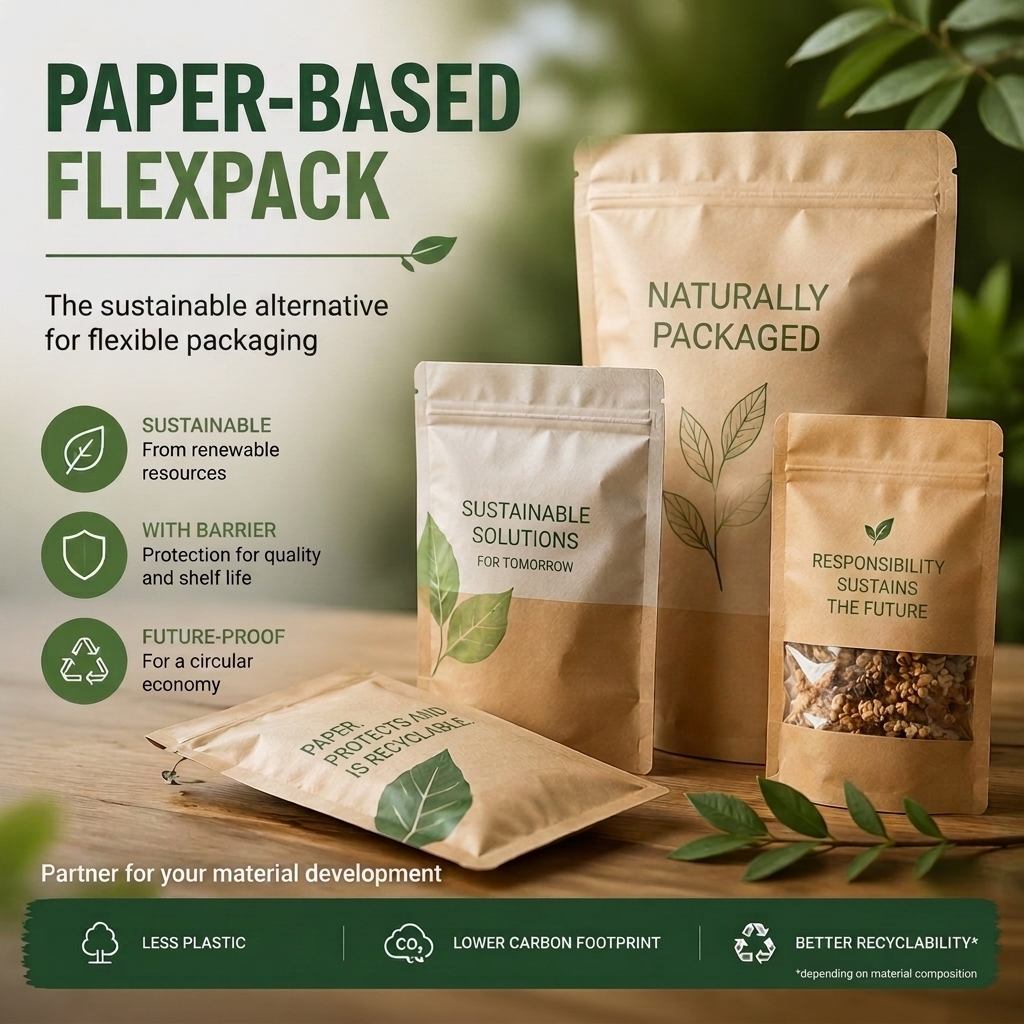
How can flexible packaging be designed more sustainably without sacrificing necessary barrier properties? This central question was the focus of our web seminar Flexpack made of Paper with Barrier – an Overview.
Together with speaker Christian Lutze from KÄMMERER Spezialpapiere GmbH, it became clear: barrier papers are a dynamically growing field with great potential – and already today a powerful response to the key requirements of the packaging industry.
Why barrier paper is becoming increasingly relevant
The packaging market is undergoing change – and barrier papers are developing into one of the most exciting future fields. Regulatory impulses such as the PPWR and the discussion around PFAS are giving this development additional tailwind.
Barrier papers impress with clear advantages:
- Use of renewable raw materials
- Integration into existing recycling streams
- Reduction of complex plastic composites
Crucial for success is the tailor-made application: the most technically and ecologically sensible solution can be specifically designed for each application – this is precisely where the strength of modern barrier papers lies.
What modern barrier papers can achieve
A key finding of the web seminar: The performance of modern barrier papers has developed impressively in recent years.
Today, the following are possible, among others:
- Grease and water barriers for food packaging
- Water vapor barriers for sensitive products
- Oxygen barriers up to demanding applications
- Heat-sealability for machine processing
Even demanding applications such as cocoa, snack, or even butter packaging can now be realized based on paper – in many cases even entirely without aluminum.
The decisive question: Which barrier does my product need?
A valuable learning from the seminar: Barrier papers can be tailor-made to the respective product – this makes them so versatile.
The optimal design is based on:
- Product type (dry, greasy, hygroscopic, sensitive)
- Storage period (short vs. several weeks)
- Environmental conditions
- desired shelf life
This results in a wide range of solutions:
- Simple wrapping papers (e.g., bakery, fast food)
- Medium-barrier paper (e.g., fresh produce)
- Barrier paper for dry food (snacks, muesli)
- High-barrier solutions (e.g., cocoa, chocolate)
- Ultra-high-barrier (e.g., spices, coffee)
The targeted selection ensures the best combination of functionality, cost-effectiveness, and recyclability.
Technological diversity: More than “just paper”
Another exciting aspect: barrier paper is an intelligently designed system with a wide technological range.
Various coordinated processes are available for production:
- Laminating (composites with films)
- Extrusion (plastic application)
- Metallization (e.g. aluminum)
- Aqueous coatings (polymer-based coatings)
Aqueous coatings in particular are gaining in importance: they require particularly small application quantities – a real plus point for recyclability and a field with high innovation dynamics.
Regulation as a driver of opportunity: PPWR and PFAS
The European Packaging and Packaging Waste Regulation (PPWR) was a central topic – and acts primarily as a powerful engine of innovation for the industry.
Key points:
- Goal: high recyclability of packaging
- Classification of barrier papers according to the proportion of fiber-based components
- growing demand for PFAS-free solutions – a field in which barrier papers are already convincing today
From 2030, clear requirements for the recyclability of paper packaging will apply – a strong tailwind for innovative, circular solutions.
From concept to series maturity: Success factors in implementation
To ensure that barrier paper achieves its full potential, it is worth considering some key adjustment parameters from the very beginning – this is precisely where KÄMMERER offers well-founded support:
- Material design: the choice of the suitable raw paper as a solid foundation
- Coating: tailored formulations for the respective requirements profile
- Processing: specifically utilizing the unique properties of paper
- Machine suitability: with targeted adjustments for smooth series production
Those who involve sealing processes, adhesives, and machine parameters early on will arrive quickly and safely at a market-ready solution.
Sustainability: well-founded and differentiated thinking
A particularly valuable aspect of the seminar: sustainability in barrier paper is considered holistically – for solutions that are truly viable.
Key classifications:
- Paper is based on renewable raw materials
- Recycling cycles are established and efficient
- the greatest leverage lies in the optimization of the overall system
- this creates solutions with real ecological added value
An important conclusion: The major ecological advantage of paper lies in its recyclability – an argument that carries more and more weight in an increasingly circular economy.
Conclusion: Great opportunities with a clear look ahead
The web seminar impressively showed: barrier papers are a central building block for the packaging solutions of tomorrow.
Crucial for success are:
- precise definition of requirements
- suitable material combination
- early involvement of processing
- consideration of regulatory guidelines
Development is progressing rapidly – especially with bio-based and PFAS-free coatings. For companies getting in now, great opportunities are opening up.
Your next step
Would you like to check whether barrier paper is suitable for your application?
Our experts will be pleased to support you with the evaluation, selection, and design – from the idea to implementation.
👉 Please contact us or visit one of our upcoming events: Current events
