
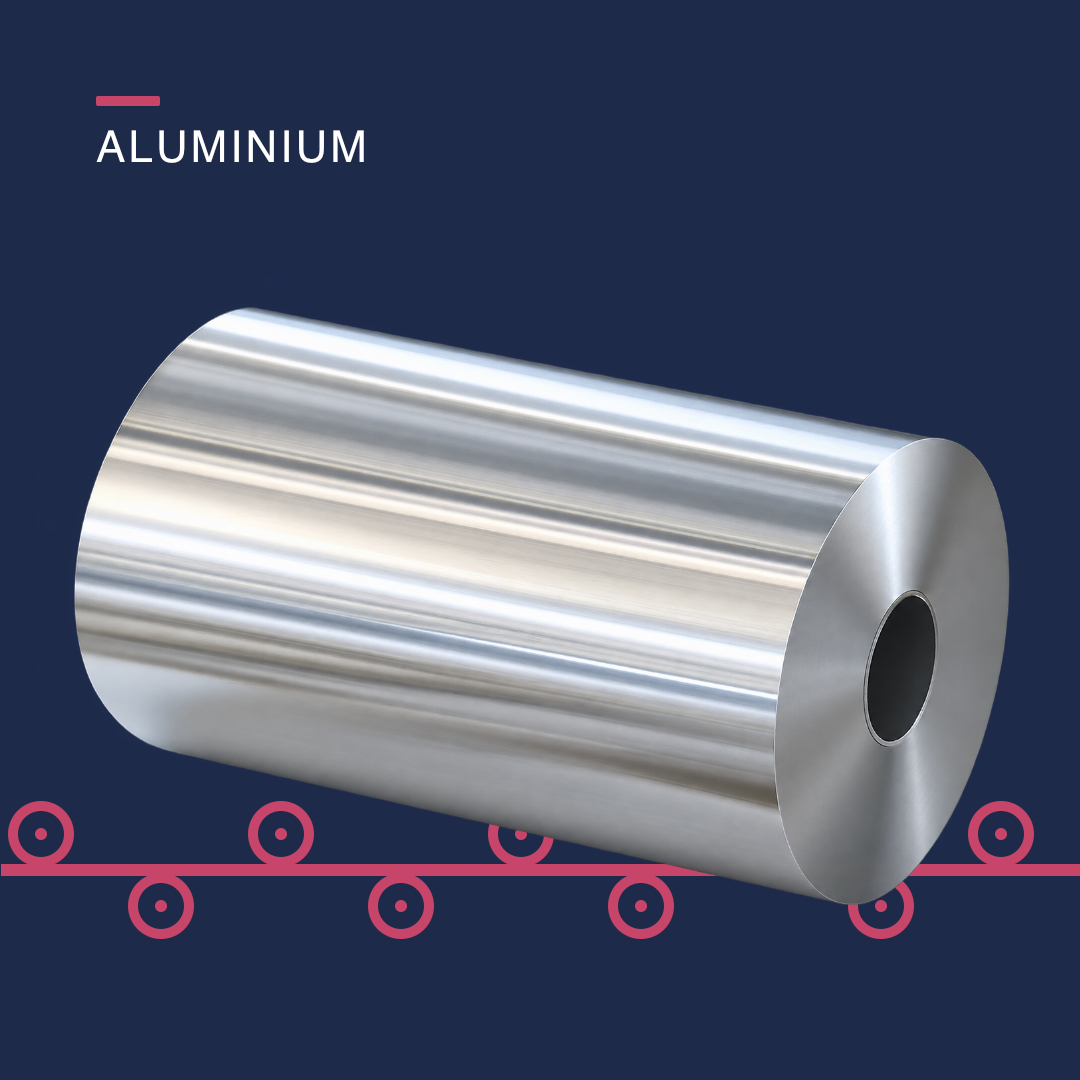
Aluminum foil is indispensable in many demanding packaging applications. But what actually makes this extremely thin material so high-performing? What role do alloy, foil thickness, and pinholes play? And why is aluminum particularly interesting when high barrier requirements are set for packaging?
These questions were the focus of the Innoform web seminar “Aluminum Foils for Flexible Packaging” with Dr. Günter Schubert. From aluminum production, rolling, and annealing to barrier properties, chemical resistance and its limits, the role of aluminum foil in sealing, and the comparison to metallized plastic films, he covered the entire process chain.
From Bauxite to Ultra-Thin Foil
Günter Schubert started with the production of aluminum. First, alumina (aluminum oxide) is extracted from bauxite, from which aluminum is subsequently produced by means of molten salt electrolysis. It became clear that the production of primary aluminum requires a large amount of electrical energy because the strong bonds between aluminum and oxygen must be broken.
Numerous further processing steps are necessary before a packaging foil only a few micrometers thick can be produced. After adjusting and controlling the alloy composition, ingots are cast from the liquid metal and then hot- and cold-rolled in several stages. Very thin foils are doubled before the final rolling pass, and these two foil layers are rolled together. This creates the characteristic shiny side and matte side of aluminum foil.
The Alloy Determines Important Properties
Not all aluminum foil is the same. Different alloy components influence properties such as strength, elongation, formability, and corrosion resistance.
During the web seminar, it was explained, for example, that iron-containing particles can affect the foil’s sensitivity to corrosion. The speaker also highlighted that even foils from different manufacturers with the same standardized alloy designation can differ significantly in their actual composition. Within the permissible alloy ranges, manufacturers operate within their own narrower composition windows.
For practical packaging applications, this means: Do not look at the alloy number alone, but also consider the requirements of the specific application.
Annealing: More Than Just a Heat Treatment
Another focus was final annealing. It not only influences the mechanical properties of the foil, but also serves, among other things, to remove rolling oil and adjust the wettability for subsequent converting. During annealing, the protective oxide layer thickens.
Particularly interesting for converters: Within an annealed foil roll, differences in wettability can occur across the foil width between the edge and the center. Günter Schubert explained that rolling oil in the center has to travel a longer distance outwards across the roll width to escape the roll, which is why wettability can be lower here than at the edge. Corona treatment can improve adhesion or reduce differences in wettability in certain cases. However, corona treatment is not fundamentally necessary for soft-annealed aluminum foil.
Aluminum as an Almost Perfect Barrier
One of the most important reasons for using aluminum foil is its barrier effect. In contrast to plastics, oxygen and water vapor do not permeate through the metal lattice of aluminum. Therefore, potential pinholes and defects in the foil or in the finished packaging laminate are decisive.
Another advantage is apparent at higher temperatures: While permeation rates through plastics increase significantly with rising temperatures, the barrier of intact aluminum remains fully preserved even during a sterilization process.
Pinholes: Visible, but Not Automatically a Barrier Problem
Participants discussed the porosity of thin aluminum foils particularly intensively. As foil thickness decreases, the number of pinholes can increase. Günter Schubert cited a typical order of magnitude for a 6 µm foil, for example, of up to about 1,000 or even 2,000 pinholes per square meter, but explicitly emphasized that the values can depend heavily on manufacturing, roll condition, and other process conditions.
What the key factor is: Visible pinholes do not automatically mean a loss of the required barrier performance. Using calculation models, the speaker demonstrated that aluminum laminates can still offer outstandingly good oxygen barriers even with a large number of small pinholes.
Quality testing was also explained. An aluminum foil can be inspected on a light table using transmitted light, pinholes located, optically analyzed, and their size classes and populations determined. The speaker also referenced DIN EN 546 in this context.
Packaging Processing Plays a Decisive Role
An important insight from the web seminar: It is not only the original foil that determines the barrier of the final packaging system.
Using the example of beverage cartons, Günter Schubert demonstrated how the aluminum layer can be compromised along creasing lines, bends, and in seal areas. Despite such additional damage during package manufacturing and the filling process, the packaging can still maintain a very good barrier.
In addition to the material specification itself, the entire process chain up to the finished package plays a supporting role.
Aluminum Also Supports the Sealing Process
Aluminum offers further functional advantages in addition to barrier properties. One of these is the so-called dead fold: after deformation, the foil exhibits only low spring-back forces. This can have a positive effect on the contouring of heat seals. Furthermore, aluminum’s good thermal conductivity causes rapid cooling of the seal seam by dissipating heat across the surface area of a laminate once heat application ceases, thereby improving hot tack.
Taking the beverage carton as an example, it is shown how aluminum foil enables induction sealing. In this process, the aluminum layer is heated via an alternating electromagnetic field, transferring this heat directly from the aluminum foil into adjacent thermoplastic sealing layers.
Metallization as an Alternative?
The concluding discussion also covered metallized plastic films as well as SiOx and AlOx coatings on films. Günter Schubert categorized these solutions as relevant options for significantly improving the barrier of plastic films. At the same time, he made it clear that such thin barrier layers cannot be equated with a rolled aluminum foil in terms of defects and mechanical stress resistance.
In the context of recyclable packaging concepts, these technologies can nevertheless play an important role. The key question remains which barrier is actually required for the specific product being packaged.
Conclusion: Barrier Must Match the Application
The web seminar impressively showed how many factors lie behind a seemingly simple aluminum foil. Alloy, rolling process, annealing conditions, foil thickness, porosity, coating, and subsequent packaging processing interlock.
At the same time, it became clear that evaluating packaging should not focus solely on the amount of material used. In the discussion, Günter Schubert pointed out that the risks of potential under-packaging should also be considered, as the energy input required for the packaged product usually exceeds that of the packaging many times over.
The key message for packaging developers and converters: The best possible barrier is not automatically the best solution. What matters is a technically reliable package whose material, processing, and barrier performance are tailored to the specific product and application requirements.
Particularly Interesting Highlights from the Discussion
- Thinner aluminum foils can exhibit a higher number of pinholes without automatically losing the required barrier.
- The actual alloy composition, the process conditions of the foil manufacturer, and the resulting microstructure and surface of the foil play an essential role.
- Corona treatment of aluminum can improve adhesion in certain cases, but is not generally necessary.
- Processing steps such as creasing, forming, and sealing must be taken into account when evaluating the barrier of the finished packaging material.
- Metallizations, AlOx, and SiOx coatings offer interesting barrier solutions, but behave differently technically than an aluminum foil in a laminate.
