
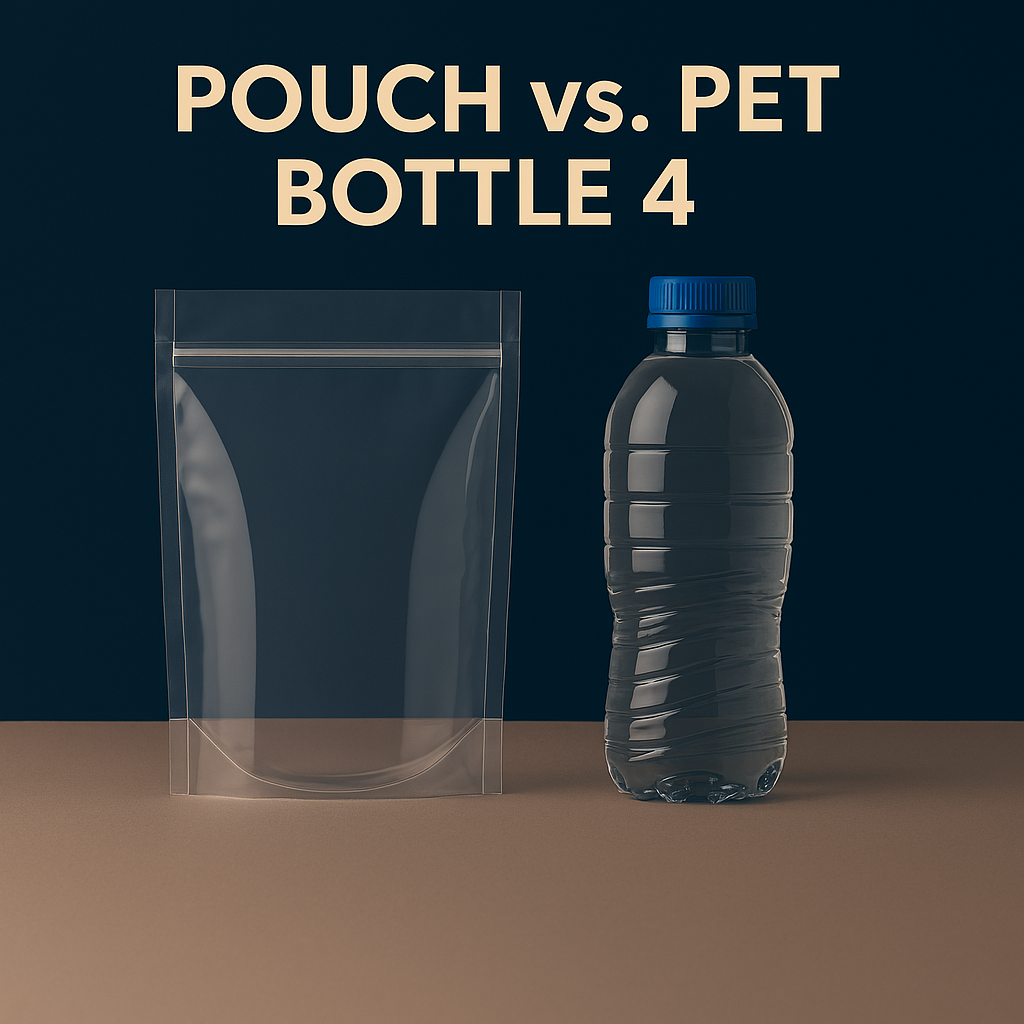
PP stand-up pouches vs. PET bottles for high-quality and sensitive fillings – a report by Dr. Bernd Knierbein
As by January 2026, part 4 from 5, part 3 here:
4. Processes after filling
4.1. Preservation
4.1.1. Sterilisation of the pouches
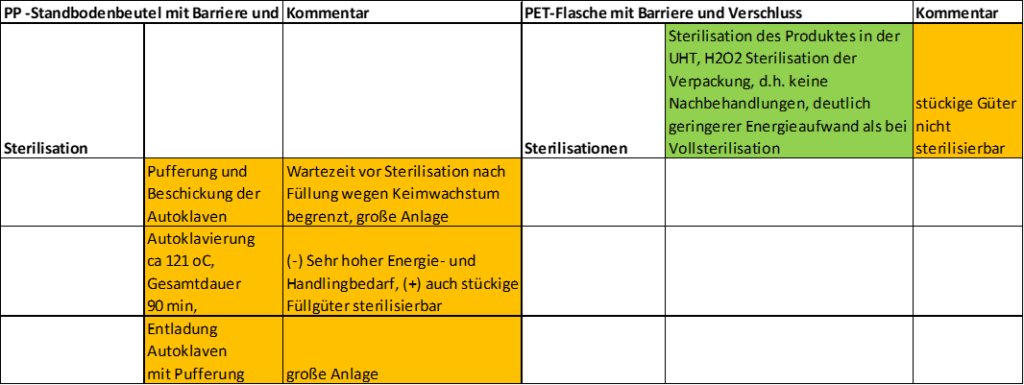
The filled bags must be prepared as follows for sterilisation in a standard bench-top autoclave:
- Precise, layer-by-layer placement of bags on suitable stackable trays
- Stacking of the trays
- Assembling the stacks of trays into batches, each sufficient for one autoclave load.
- These conveyors are used to load either a single autoclave or, alternately, several autoclaves.
The standard sterilisation temperature is 121 °C. The sterilisation cycle, including heating, holding and cooling, usually takes 90 minutes. The waiting time before autoclaving must not be too long, in order to prevent excessive pre-contamination of the product.
The autoclaves are unloaded in the reverse order to loading:
- Unloading the autoclaves in batches
- Final unstacking of the individual tray stacks
- Unloading of the individual trays
These processes are very labour-intensive:
- High level of automation required for loading and unloading
- High energy and resource consumption for sterilisation
- Requires a great deal of space; the equipment is very heavy
The main advantage of these processes is that they can also be used to preserve chunky products such as rice or pieces of meat (e. g. pet food).
Typical illustrations of these loading and unloading processes can be found in /28/ and /29/.
Alternatively, continuous sterilisation can be used, which involves less handling but has a different set of characteristics that will not be discussed in detail here.
4.1.2. Aseptic filling
The sterilisation of the product using UHT, the H₂O₂ sterilisation of the packaging and the aseptic filling are already described in section 3.2.3; in other words, no further post-treatment of the product is required for the bottles after the filling process.
Table for Section 4.1: Preservation
4.2. Final packaging and logistics
4.2.1. Final packaging of the pouches
As pouches are more fragile than bottles, they need to be better protected during logistics and transport:
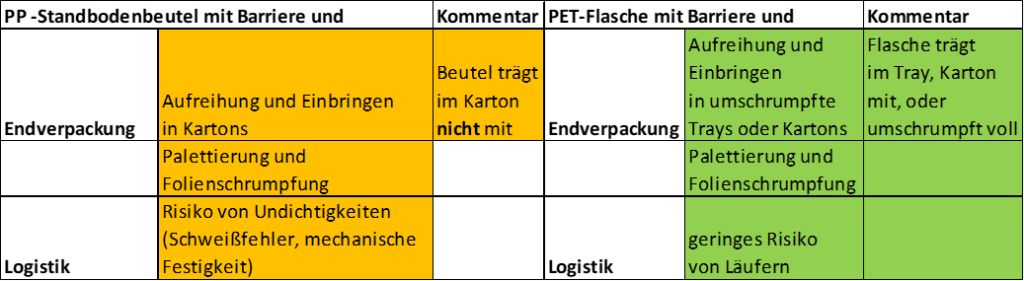
- The sterilised bags must be lined up, sorted, picked up and gently placed into cartons for final packaging. A stacking process on the conveyors, as is done with bottles, is not possible here.
- Due to the sharp edges of the film caused by the design, care must be taken to ensure that the bags do not tear each other during these processes.
- When arranging the cartons, it is important to keep in mind that the bags do not contribute to the weight; in other words, the bottom carton on a pallet must be designed to withstand the impact loads of the entire load above it (self-supporting cartons).
- Once the boxes have been palletised, the pallet can be wrapped.
- Risk: If there are leaks, for example due to welding defects, this can cause very significant consequential damage in the warehouse or during transport, as even pallets stored further down the stack can be damaged by leaking product.
4.2.2. Final packaging of the bottles
Handling bottles is easier than handling pouches, as when full they are rigid or semi-rigid containers:
- In many cases, accumulation and buffer zones are possible, and simple conveyors are sufficient for transporting the containers.
- Furthermore, the impact resistance of PET containers is significantly better than that of polyolefin pouches.
The following concepts can be used for transport packaging:
- Direct shrink-wrapping of bottle packs and their palletising, with cardboard interlayers where required
- Groups of bottles on simple trays with shrink-wrapping
- Groups of bottles in cartons that do not need to be self-supporting
Table for Section 4.2: Final packaging and logistics
Sources:
/28/ https://lanhandling.com/de/retort-room-automation/
/29/ https://jorgensen.dk/industry/healthcare/
