
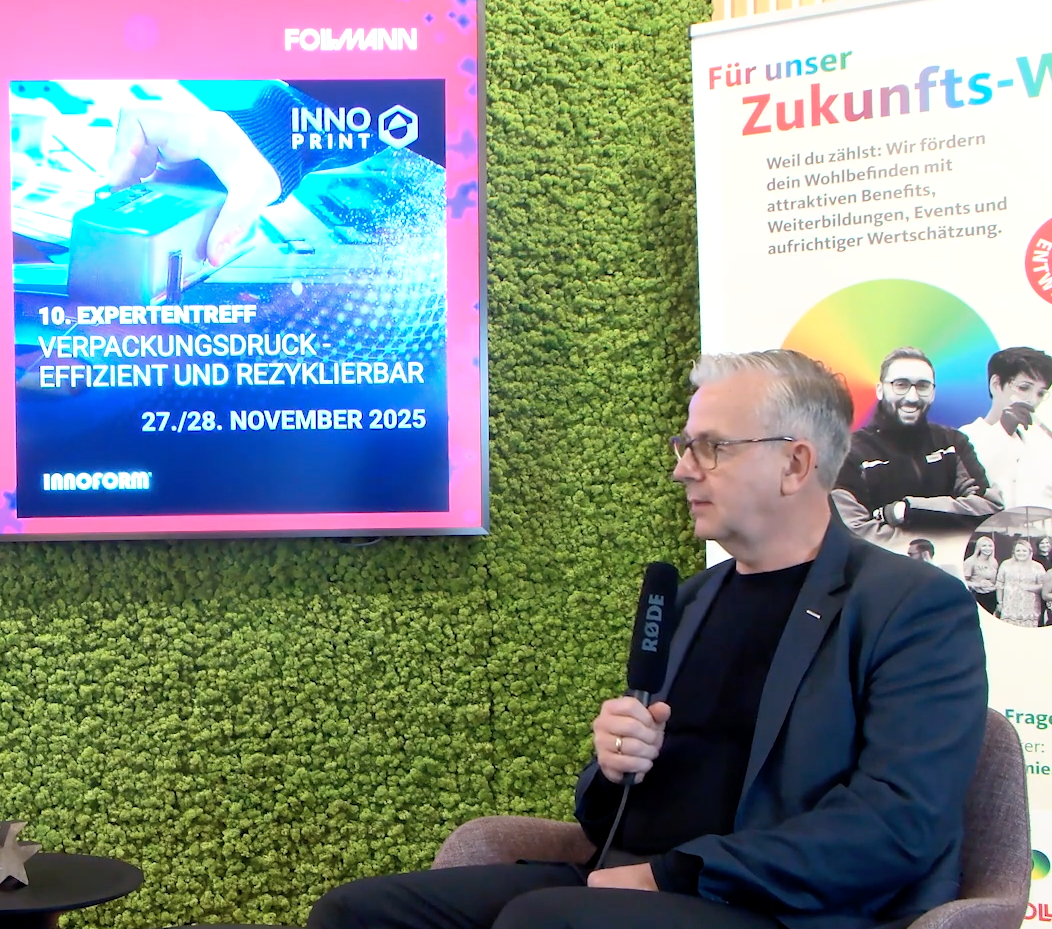
In the latest Innoform podcast, Julian Thielen talks to Dieter Niederstadt from Asahi in aftermath of the 10th Packaging Printing Expert Meeting Inno-PrintPack about a topic that has been preoccupying flexographic printers for years: How can quality, productivity and sustainability be reconciled in printing plate production?
Asahi relies on water-washable flexographic printing plates and a comprehensive “AWP Water Washable Ecosystem”. The approach: fewer solvents, more automation and more stable printing results – especially for demanding packaging applications.
Asahi Kasei Part of Asahi Kasei : Chemicals group with a focus on flexographic printing
Asahi Kasei is a Japanese chemical company with around 50,000 employees worldwide. In addition to electronic components and speciality fibres, the printing forms division also plays an important role.
Asahi’s flexographic printing plates are primarily used in packaging printing – for example, on films, labels and paper-based substrates. The podcast provides a glimpse behind the scenes of this business area and shows how much plate technology has changed in recent years.
The AWP Ecosystem: Plates, Equipment and Recycling
At the heart of the approach is the AWP system (Asahi Water Washable Plate). Dieter Niederstadt describes it as a complete ecosystem that goes far beyond the plate itself.
Components of the system
- Equipment:
Batch washing systems for smaller volumes and inline washers for highly automated lines. The aim is to guide the plate through all process steps with as little manual intervention as possible. - Plate types:
Flat-top and round-top plates for different applications, combined with different plate hardnesses. Harder for the highest quality, softer for applications with high surface coverage or rougher substrates. - Recycling:
The process water and washed-out polymer components are also considered in the system in order to achieve the highest possible recovery rates and conserve resources.
From blank to finished printing form
The basic steps are similar to the familiar solvent technique:
- Laser engraving of the black mask on the blank plate
- Exposure to UV light (front and back)
- Washing out the unexposed areas
- Post-exposure and finishing
The key difference: the plate is washed out with water. No volatile organic solvents are required, which also eliminates the need for an energy-intensive drying process.
90% time savings for the brush operator thanks to automated water washing lines
The conversation highlights how significantly process times can vary. Asahi compares traditional solvent-based production with an automated AWP line:
- With solvent plates, in addition to exposure and washing, drying is the most critical step – including residual solvent in the plate and correspondingly long throughput times.
- With water plates, these drying times are not necessary. After washing, the water is blown off with air at room temperature, followed immediately by post-exposure.
Asahi estimates the reduction in operator time in typical configurations to be around 90%. In busy pre-press departments in particular, this means greater flexibility for more demanding tasks. Especially in times of skilled labour shortages, simple and repetitive tasks can thus be compensated for by full automation.
Flat plates instead of “plates”: quality in printing
Another key topic in the podcast is dimensional stability.
Problem: Plates on solvent plates
Residual solvent always remains in the polymer of solvent-based washed plates. The result:
- The plate swells after the washing process.
- During drying, the solvent is never removed 100%.
- In practice, this often leads to the well-known “warping” – the board no longer lies flat, which must be compensated for with stronger adhesive tapes and additional fixing.
Advantage: Water plate remains flat
The situation is different for water-washable AWP boards:
- No solvent enters the board.
- The plate thickness is identical before and after the washing process.
- The plate lies flat on the table and on the cylinder.
This simplifies setup, stabilises the register and supports reproducible printing results – especially with fine screens above 200 lpi and very small dots.
Surface tension as a lever for clean transmission
One technical detail that is discussed in detail in the podcast is the surface tension of the printing plate.
- Anilox rolls typically have a surface tension of around 20 dyn, substrates around 40 dyn and higher.
- Classic flexographic plates often have 36–38 dyn.
Asahi specifically reduces the surface tension of the sheet by adding additives to the polymer. The result:
- The paint comes off the panel more easily.
- The dimples of the anilox roller empty more cleanly.
- The plate remains “cleaner” even after long runs – less dot gain, less clogging of fine halftone dots.
Important: This effect is integrated into the polymer structure and remains effective even after tens of thousands of metres of running. A practical “workaround” mentioned in the podcast – applying silicone spray to the plate – loses its effect after a few thousand metres, whereas the integrated solution has a lasting effect.
Compatible with all common colour and substrate systems
Asahi positions AWP boards as universally applicable:
- They can be used with water-based, solvent-based, UV and EB inks.
- Asahi sees great potential in water-based inks in particular, as controlled surface tension enables very even ink transfer.
- Depending on the substrate – from stretchable films to absorbent papers – different plate hardnesses are used to optimally compensate for the topography of the printing material.
For printing companies, this means that switching to water-washable plates does not require a complete rethink of their ink or substrate portfolio.
Sustainability, occupational safety and skills shortage
In the background, there is a bundle of challenges that are touched upon in the podcast:
- Fewer solvents: No handling of flammable solvents, no distillation, lower emissions and less effort required for occupational safety and permits.
- Energy efficiency: The elimination of long drying phases reduces energy consumption.
- Automation: Inline systems, robotics and reduced manual intervention relieve the workload on staff and compensate for the shortage of skilled workers in the pre-press stage.
Appeal to flexographic printers: demonstrate a willingness to innovate
Dieter Niederstadt concludes by emphasising that water-washable plates are not a brand new idea – they have been on the market for over ten decades. However, he points out that quality, process stability and the degree of automation have improved significantly in recent years.
His conclusion to flexographic printers:
- Consciously testing new technologies,
- Compare results in your own process
- and not draw conclusions about the present from previous generations.
Those who use water-washable AWP plates in conjunction with modern automation today can achieve noticeable progress in terms of quality, productivity and sustainability.
As usual, you can find the complete Innoforum podcast with all technical details and practical examples on the usual podcast platforms.
Leave a Reply
You must be logged in to post a comment.