
A short report by Karsten Schröder
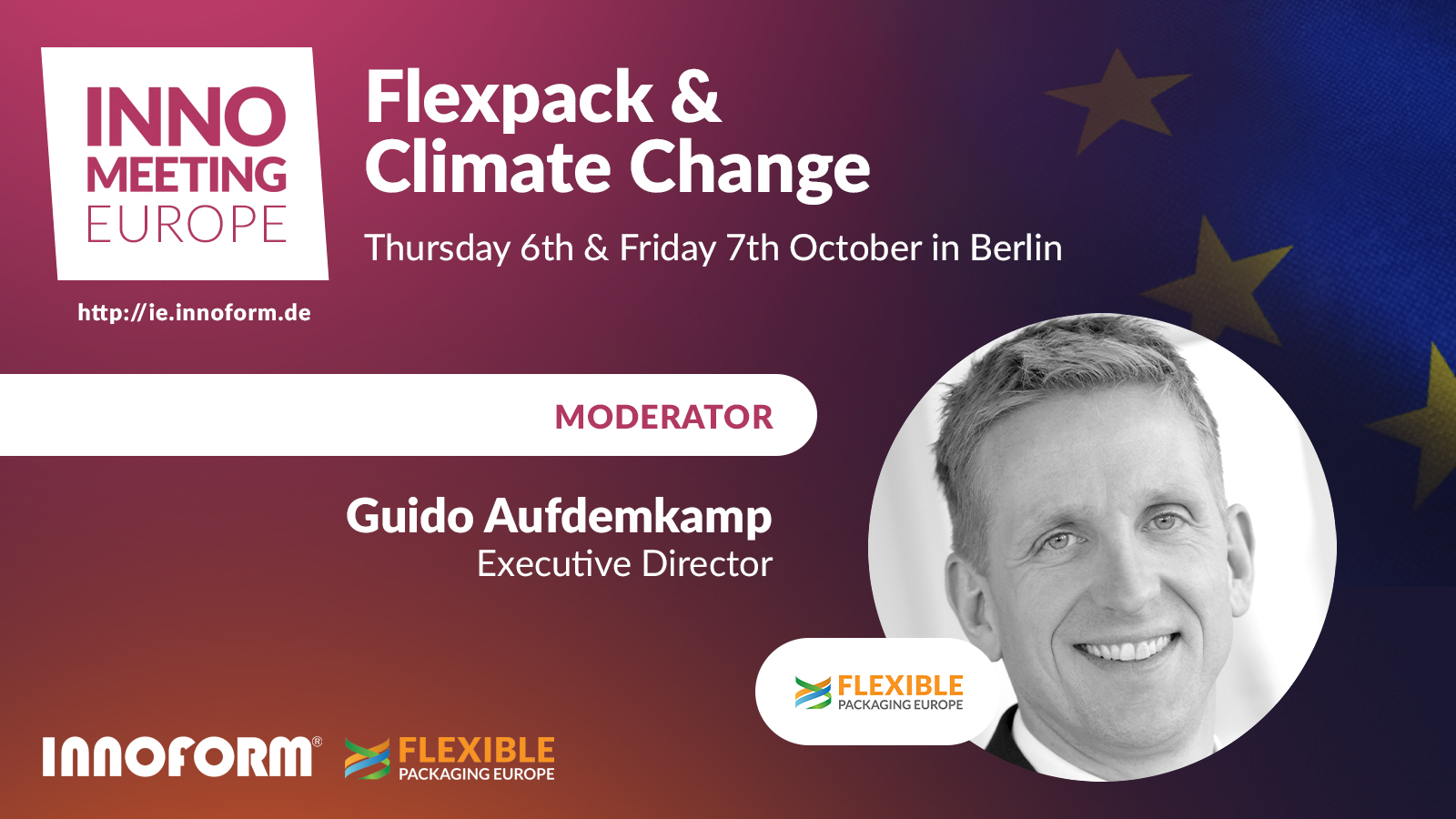
Moderated by Guido Aufdemkamp, the Inno-Meeting Europe was an entertaining, informative and collegial meeting of the on-site and livestream participants. Together with the top-class speakers, the atmosphere was extremely friendly and constructive.
It started with facts, figures and data from Flexible Packaging Europe (FPE). Anja Holthoff-Schlegel, connected from quarantine, spoke about the expected growth in the volume of flexible packaging. Where does the growth come from in times of reduction and circular economy? Primarily, everything revolves around growing consumption, which is forecast throughout Europe.
With Dr. Günter Schubert we went into technology and we learned that aluminium foils in beverage cartons are not only responsible for the barrier. On the contrary – alumium is a process aid that improves sealing, guarantees deadfold and stays tight at the same time.
Sun Chemical, represented by Ewald Rempel, presented its sustainability strategy based on the UN Goals. Printing inks can also improve recyclability and become more sustainable themselves.
BOPP films were the focus of Dr. Daniele Borin (Taghleef). And not just BOPP with the familiar properties, but with excellent oxygen and aroma barriers. The multi-layer, biaxially oriented BOPP films now enable converters to produce mono-material packaging based on PP. These are also considered particularly recyclable in mechanical recycling.
Sabrina Schmidt offered a guide for packers that was developed in a multi-year research project with DM and ifeu Institut, among others. This guide, called INNOREDUX, can be downloaded free of charge: https://www.ioew.de/publikation/verpackungen_oekologisch_optimieren. Learn why unpacked goods are not always the most sustainable.
The two speakers Dr. Andrey Charkovskiy and Ir. Disha Disha from Siegwerk Druckfarben promoted high-quality, recyclable film packaging. Here, too, the tenor was: We are enablers of the circular economy with flexible packaging – with and without barriers. Because Siegwerk also offers barrier coatings, e. g. for paper packaging, as well as washable printing inks for so-called DEINKING.
Wattron, represented by Ton Knipscheer promised up to 90 % energy savings with digital sealing tools. Thus, 5×5 millimetre small pixels are controlled at 100 Hz and heated individually according to heat consumption. In this way, exactly the amount of heat arrives that is needed for mono-material packaging, for example. This award-winning invention amazed the room and will make the start-up successful, according to the unanimous assessment of the auditorium.
According to Alexander Bockisch, Henkel sees itself not only as an adhesives manufacturer, but also as a design partner in the best sense. In the middle of the supply chain, Henkel wants to create sustainability and added value with adhesives and new ways. After all, bonded composite films are also increasingly easy to recycle and offer high performance – impossible to imagine without them, isn’t it?
Paper where possible and plastic where useful – has almost become a saying in our industry. Thomas Kahl describes why Mondi is going down this path and is strictly oriented towards the customers´ needs and requirements of the market. This is a call for openness towards materials.
Representing the retail giant DM, Dagmar Glatz showed profound expertise in printed packaging and amazed with her involvement in the PrintCYC research project, the results of which Dr. Annett Kaeding-Koppers explained in more detail below. Printing inks, even if they are not removed, can be optimised to minimise side effects during recycling, such as speckling, colour deviations and odour. „Grey is the new green“ one could say.
Prof. Markus Schmid had a big surprise in store. He urged foresight and suggested the organic circular economy as an essential complement to the fossil circular economy and referred to the first research results from a sustainability institute in Sigmaringen.
PET films are dead – long live PET films – one could summarise from Ralf Meyer’s article. Why does flexible packaging actually have to be made of mono-material based on polyolefins? Monopolyester films can also be used, which can be fed into PET bottle recycling, for example – all mono-material as well! The advantage: Everything can remain as it is on the packaging machines.
Xavier Bonamour’s presentation for the machine manufacturer BOBST focused on „Save Food“ through high and ultra-high barriers on film and paper using a combination of vapour deposition and coatings. BOBST has developed ready-made solutions on various substrates in recent years and now offers everything to interested converters under the name oneBARRIER.
„Small parts, big effect“ is what Mike Landwehr said about the 10 % mass reduction in shrink-wrapped parts for stand-up pouches etc. But that is not all – customised shrink-wrapping solutions made from regenerated material are also available today and are just finding their way onto the shelves.
Fernando Gordillo emphasised that digital printing is the most resource-efficient printing process. Not only the energy requirements, consumables etc. are optimised, but also waste and overproduction are a thing of the past. But digital printing only becomes really interesting with digital business models – here we go.
For all those who want to see my final, here is the live recording.
TIP: If you are interested in viewing all or selected presentations and downloading the documents, here is a reduced introductory offer for the 1st Inno-Meeting Europe. You save 200,- € on the regular price.
A first Inno-Meeting for Europe, but not the last one.
Text: Karsten Schröder
Video: www.eveema.com
Transkript
and I would like to go quick through the yeah to all the presentations with one slide. We started yesterday. You may remember that Anja told us everything is growing. And I don’t know how this will happen in the future because the planet does not grow. We think we have the answer with the circular economy. Maybe that’s the truth and you told us that in several brands in several markets in several branches still growing the consumption is growing.
So the packaging has to grow and we as a flexible packaging will be a part of this. Then Guntur thank you for this. I would say scientific insights to the carton beverage boxes and the role of aluminum film in this box. I learned a lot. I thought it’s just for barrier but it isn’t it is a process help. It helps the process to become a good carton box and especially with these refillable.
Yeah convenience add-on, I would say thanks Gunter for this very nice presentation and that if I told us that Sun is working based on the UN goals to develop their printing inks to make the flexible packaging and not only the flexible packaging more recyclable. That’s really interesting that all along the supply chain. Everyone said the same more or less concerning the circular economy. Thanks Evil to do. So and next presentation was from Daniele and he told me that OPP is the future.
Thanks to give us this insight and of course. PP does not have a good oxygen barrier, but you manage it with a special construction with special co-extrusion and coatings are whatsoever. And you know, you can have a polypropylene based barrier packaging for all kind of flexible packaging and you manage it. Thank you so much to be with us here in Berlin and then we came to again a scientific presentation from Sabrina and he said involving the right stakeholders and that’s what we are doing here.
Thanks for this insight of the guideline how to decide which packaging from a retailer perspective or from consumer perspective. It’s the best in terms of sustainability. Thanks for this interesting presentation yesterday and then Disha and Andrew. It’s a pleasure to have you here a nice duet. I would say with all around improving recyclers, but not only that you told us that barrier thing is also a very important topic of secret and you would like to enable others to become better in terms of sustainability.
Thanks for being with us here in Berlin. And then Ton I think one of the highlights to be honest towards the other. Sorry, but one is the winner in this for my point of view turn with your startup and the sealing technology. You enable the sealer the sealing companies to reduce energy consumption by more or less up to 90%. That’s really tremendous and you improve the quality maybe by the same level.
Thanks so much for helping the startup become a real big company and valid company for the Flexpack industry as well. And then we heard from Alex at Henkel is not only an adhesive manufacturer or supplier. He wants to be a design partner or become a design partner along the supply chain. And this is one of the brackets I would say around this conference that we all talk about the cooperation of the whole supply chain. Henkel is in the middle of that and I think it’s a good idea to talk to them.
Once again also making with adhesives new business models happen or to at least the Flexpack industry more sustainable. Then to my skull live from Vienna in the live stream. He’s focusing on customer demands and that’s what we do all I think and he honestly said, yeah, we are focusing on what the customer wants to have to help them and the slogan „paper where possible and plastic when useful“ is something everyone uses in our branch at the moment. That’s really interesting, fiber-based.
Materialknappheit und Retailer-Verantwortung
Material is pushed by not only by Monday or by the others, but it is limited. That’s what he told us as well. So we need other materials as well. Thanks Dogma for being with us this morning, the retailers, of course the OEMs of the Flexpack industry, perhaps — I don’t know, it’s maybe some 10 years ago. I remember an Inno-Meeting in Germany, in German in Austin work.
We are one speaker said why don’t the retailers become the OEMs and why don’t they push us or pull us into the right direction and it happens now, we heard it. Dogma, she’s in depth involved in the developments of yeah, recyclable printed flexible packaging and they try to reuse, reduce like we all do, thanks for this contribution and Annette. Of course, she’s fighting for the recyclable printing inks. And of course another scientific presentation.
Thanks to be with us and good luck with the project and maybe the second stage and then we came to Marcus, the professor, the only professor in this meeting, but not too scientific to be honest, but you gave us a different perspective of the circularity, bio-circularity is your motto and I like this. I really am convinced that this is one of the solutions for us as a Flexpack industry. Not only plastic, not only fiber base. It’s bio-based maybe and a bio-circularity. Thanks Marcus for being with us today.
It was really a pleasure to have you here and there’s not only mono polyethylene. There’s also mono polyester. That’s interesting to me. Why do we not think about monpolyester PEX flexible leadings? And for instance deep-drawn polyester tray? That sounds great to me. And I’ve seen it in the shelf several times. It works. I don’t know who’s the winner, is polyester has the big advantage that it is very easy to recycle and we have a recycling stream, great thing, news for me. So seven.
Yeah, thank you so much for being here. One barrier also to improving the barriers, one of the major topics to make flexible packaging more sustainable, to protect or to prevent food waste. We would, we have to prevent food waste. That’s our goal. Not only to make plastic or paper recyclable. We have to prevent food waste and thanks for this idea with one barrier and 10 years of work. We had the podcast made with Tomas and one of the other innovators from the UK.
We have 3,000 downloads now and we guaranteed that we have in February 5,000, Thomas. We will have a look in February. Mike, thanks for being here. The spout is only a small part in the Flexpack industry, but it’s important and you convinced me that it’s worth being into depth, into all details with the spout. Only 9%? You said it’s only 9%? Hey, it’s 9% less. Wait, it’s great. It’s one lowery a month or so. I don’t know, it’s brilliant. I like these, these approaches to go into deep detail. I like it. Thanks Fernando.
I did not know that digital printing is really so sustainable. I like it. I like digital printing anyhow, but knowing that it’s more sustainable than flexo and gravure, especially for short runs. It’s fantastic. We should use it more and we make it more sustainable, maybe adding other, yeah, properties like barrier or things like mentioned in your presentation. Thanks so much, gracias, at the it was a great new meeting.
I think and I would like to thank you to the whole Innoform team at least to help us have making this a success story and I hope it was the first but not the lead last Inno-Meeting Europe. Thank you. By the way.
Kostenlose Innotalk-Expertengespräche
We have some Inno-Talk prepared for you. You know, every third Friday a month you can join for free the Inno-Talk and you’re by heart invited to become a supporter of this. The next Inno-Talk in English will be this, a bit complicated topic, progressive flexible Flexpack recycling technologies in our talk group moderated by Giro, once again, and one speaker is already announced from BASF. We are talking about recycling ideas of BASF and we’re waiting for the next speaker coming soon.
So please have a look at innotalk.eu or .de, like you want, and I really invite you to the expert for packaging, stroke, for all the people who speak and understand German. We are going into depth concerning printing technologies: digital printing, flexo printing, offset printing, gravure printing, whatever you want, we go through all the processes and a bit more into detail concerning printing than we did today.
Thanks to you all have a nice weekend coming soon back to Innoform or FPA FPE have a nice lunch over there and all the people in the livestream. Thanks for being with us. You are supporting this initiative for more Flexpack knowledge in Europe. Thanks. I would like to go quick through the yeah to all the presentations with one slide. We started yesterday. You may remember that Anya told us everything is growing. And I don’t know how this will happen in the future because the planet does not grow.
We think we have the answer with the circular economy. Maybe that’s the truth and you told us that in several brands in several markets in several branches still growing the consumption is growing. So the packaging has to grow and we as a flexible packaging will be a part of this. Then Guntur thank you for this. I would say scientific insights to the carton beverage boxes and the role of aluminum film in this box. I learned a lot. I thought it’s just for barrier but it isn’t, it is a process help.
It helps the process to become a good carton box and especially with these refillable, yeah convenience add-on, I would say thanks Guntur for this very nice presentation and that if I told us that Sun is working based on the UN goals to develop their printing inks to make the flexible packaging and not only the flexible packaging more recyclable. It’s really interesting that all along the supply chain. Everyone said the same more or less concerning the circular economy.
Thanks Eva to do so and next presentation was from Daniele and he’s told me that OPP is the future. Thanks to give us this insight and of course. PP does not have a good oxygen barrier, but you managed it with a special construction with special co-extrusion and coatings are whatsoever. And you know, you can have a polypropylene-based barrier packaging for all kind of flexible packaging and you manage it.
Thank you so much to be with us here in Berlin and then we came to again a scientific presentation from Sabrina and he said involving the right stakeholders and that’s what we are doing here. Thanks for this insight of the guideline how to decide which packaging from a retailer perspective or from consumer perspective. It’s the best in terms of sustainability. Thanks for this interesting presentation yesterday and then Disha and Andrew. It’s a pleasure to have you here a nice duet.
I would say with all around improving recipes, but not only that you told us that barrier. Is also a very important topic of secret and you would like to enable others to become better in terms of sustainability. Thanks for being with us here in Berlin. And then Ton I think one of the highlights to be honest towards the other. Sorry, but one is the winner in this for my point of view turn with your startup and the ceiling technology.
Energieeinsparung in Siegelmaschinen
You are enable the sealer the ceiling companies to reduce energy consumption by more or less up to 90% That’s really a tremendous and you improves the quality maybe by the same level. Thanks so much to helping the startup become a real big company and valid company for the Flexpack industry as well. And then we heard from Alex at Henkel is not only adhesive manufacturer or supplier. He wants to be he designed partner or become a design partner and along the supply chain.
And this is one of the brackets I would say around this conference that we all talk about the corporation of the whole supply chain. Henkel is in the middle of that and I think it’s a good idea to talk to them. Once again also making with adhesives new business models happen or to at least the Flexpack industry more sustainable. Then to moscal live from Vienna in the live stream.
He’s focusing on a customer demands and that’s what we do all I think and he honestly said, yeah, we are focusing on what the customer wants to have to help them and the slogan paper where possible and plastic when useful is something everyone uses in our branch at the moment. That’s really interesting fiber-based material is pushed by not only by only also by the others, but it is limited. That’s what he told us as well. So we need other materials as well.
Thanks Dogma for being with us this morning the retailers, of course the OEMs of the Flexpack industry perhaps, I don’t know it’s maybe some 10 years ago. I remember an Inno-Meeting in Germany in German in Austin work. We are one speaker said why it doesn’t the retailers become the OEMs and why don’t they push us or pull us into the right direction and it happens now we heard it.
Dakma, she’s in depth involved in the developments of yeah, recyclable printed flexible packaging and they try to reuse reduce like we all do thanks for this contribution and Annette. Of course, she’s fighting for the recyclable printing inks. And of course another scientific presentation.
Thanks to be with us and good luck with the project and maybe the second stage and then we came to Marcos the professor the only professor in this meeting but not too scientific to be honest, but you gave us a different perspective of the circularity bio-circularity is your motto and I like this. I really convinced that this is one of the solutions for us as a Flexpack industry. Not only plastic not only fiber base. It’s bio-based maybe and a bio circularity. Thanks Marcus to being with us today.
It was really a pleasure to have you here and there’s not only mono polyethylene. There’s also mono polyester. That’s interesting to me. Why do not thinking about monopolyester PET flexible leadings? And for instance deep drawn polyester tray. That sounds great to me. And I’ve seen it in the sheriff several times. It works. I don’t know who’s the winner is polyester has the big advantage that is very easy to recycle and we have a recycling stream great thing news for to me. So seven years.
Thank you so much for being here one barrier also to improving the barriers one of the major topics to make flexible packaging more sustainable to protect or to prevent food waste. We would we have to prevent food waste. That’s our goal. Not only to make plastic or paper recyclable. We have to prevent food waste and thanks for this idea with one barrier and 10 years of work. We had the podcast made with Tomas and one of the other innovators from the UK.
Digitaldruck als nachhaltige Lösung
We have 3,000 downloads now and we guaranteed that we have in February 5,000 Thomas. We will have a look in February Mike thanks to being here. The spout is only a small part in the Flexpack industry, but it’s important and you convinced me that it’s worth being in into depth into in all details with the spouse. Only 9% You said it’s only 9% Hey, it’s 9% Less. Wait, it’s great. It’s one Lowery a month or so. I don’t know it’s brilliant. I like these these approach to go into deep data. I like it. Thanks Fernando.
I did not know that digital printing is really so sustainable. I like it. I like digital printing anyhow, but knowing that it’s more sustainable than flexor and Graveler, especially for short runs. It’s fantastic. We should use it more and we make it more sustainable maybe adding other. Yeah properties like barrier or things like mentioned it in your presentation. Thanks so much gracias at the it was a great new meeting.
I think and I would like to thank you to the whole Innoform team at least to help us have making this a success story and I hope it was the first but not the lead last Inno-Meeting Europe. Thank you. By the way.
We have some Inno-Talks prepare to you, you know every third Friday a month you can join for free the Inno-Talk and your by heart invited to become a supporter of this the next Inno-Talk in English will be this a bit complicated topic Progressive flexible Flexpack recycling Technologies in our talk group moderated by Giro once again and one speaker is already announced from BASF. We are talking about recycling ideas of BASF and we’re waiting for the next speaker coming soon.
So please have a look at innotalk.eu or de like you want and I really invite you to the expert for parking stroke for all the people who speaks and understand German. We are go into depth concerning printing technologies digital printing flexo printing offset printing grever printing whatever you want we go through the through all processes and a bit more into detail concerning printing than we did today.
Thanks to you all have a nice weekend coming soon back to Innoform or FPA FPE have a nice lunch over there and all the people in the livestream. Thanks for being with us. You are supporting this initiative for more Flexpack knowledge in Europe. Thank you.

Schreibe einen Kommentar
Du musst angemeldet sein, um einen Kommentar abzugeben.