
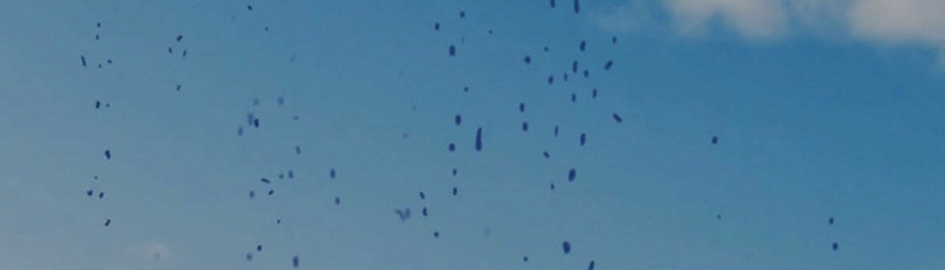
Ink Spitting (Source: pack.consult)
By Dieter Finna
Regulatory requirements aim to ensure the compliance of printing inks. However, they also affect print quality and process stability, for example when foaming and spattering of UV label inks become an issue. Together with customers, Gallus investigated the root causes of these phenomena. The insights gained led to a design solution for chambered doctor blades and the specification of doctor blades, while also challenging widespread myths surrounding dip roller systems.
Phenomena such as ink foaming, ink spitting, and blade jumping, which were considered largely under control in label printing, are suddenly reappearing with increasing frequency. “At first, the occurrence of these phenomena didn’t make sense to me,” says Alexander Feit, Customer Success Manager at Gallus. “In my many years of experience as a printer, these defect patterns were virtually under control in practice and the processes accordingly stable.”
However, the reality in print shops tells a different story: during his numerous customer engagements around the globe, Feit has found that even companies with modern press systems and experienced printers are not immune to these problems. The root causes lie deeper – in changed ink formulations, which can disrupt the previously balanced interaction of the transfer components in the inking unit.
“At first, the occurrence of these phenomena didn’t make sense to me” says Alexander Feit, Customer Success Manager at Gallus. “In my many years of experience as a printer, these defect patterns were virtually under control in practice and the processes accordingly stable.”
Alexander Feit, Customer Success Manager at Gallus
Regulation is changing the reality in the pressroom
Under the European REACH regulation and its amendments, numerous substances in printing inks have been restricted or banned. For ink manufacturers, this meant revising and adapting formulations accordingly, including the UV and LED-curing inks used in label printing. “Certain ingredients that previously had a defoaming effect are no longer permitted,” explains Alexander Feit. “The result: the inks are more prone to foaming.”
What initially appears to be purely a material issue, quickly turns out to be a systemic challenge. This is because the new ink formulations behave differently in the printing process – and encounter press technologies that were originally developed for different conditions.
When geometry becomes a problem
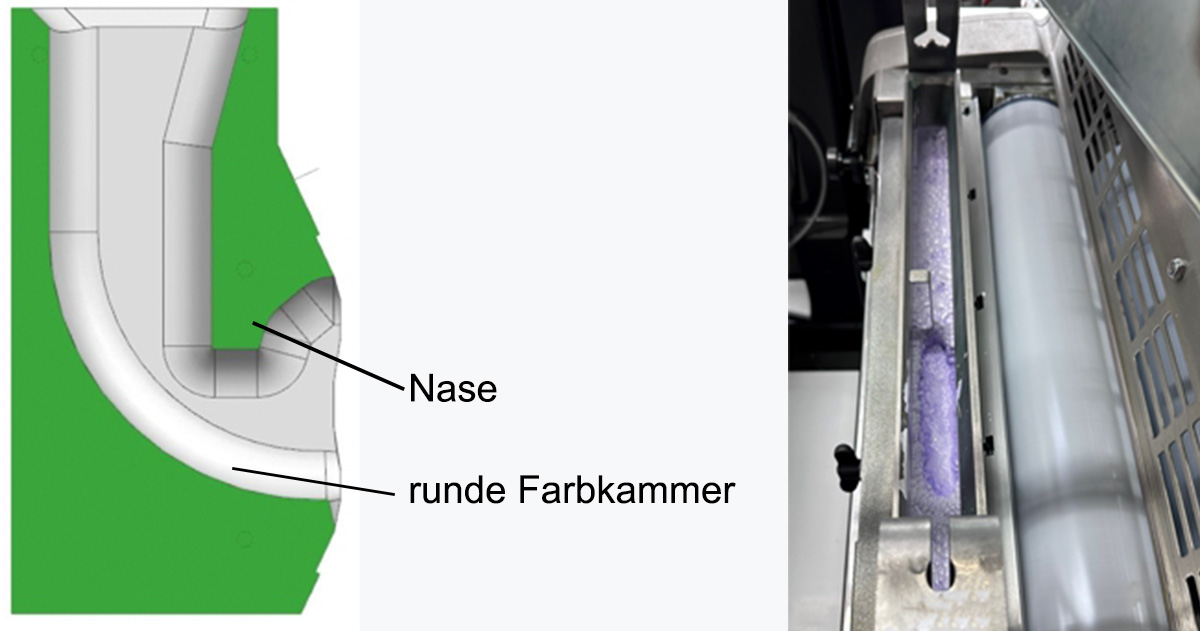
A key element in flexographic printing is the chambered doctor blade with its ink chamber. Its task is to transfer the ink evenly onto the anilox roller. However, it was precisely here that an unexpected weak point emerged. The previously used, round-shaped ink chambers, due to their geometry, generate greater ink agitation. “You can imagine it like a glass of water with a little soap,” describes Alexander Feit. “If you stir it, foam forms. That is exactly what happens in the chamber as well.”
In combination with the newly formulated, which are more prone to foaming, this effect is amplified. Air is drawn into the ink and accumulates in the system, so the anilox roller is not wetted uniformly – resulting in uneven ink application, voids, and loss of print quality.
It becomes particularly critical during production interruptions: “When the machine stops, the air bubbles migrate downwards into the chamber and exacerbating the problem – a self-reinforcing cycle.”
Small change, big impact
The solution lies in a new ink chamber geometry. Instead of the previous curved shape, Gallus adopted an angular shape for the chamber design. The result: significantly less movement in the ink, reduced air turbulence – and thus a dramatic reduction in foaming.
“We only changed the geometry – the effect was enormous,” says Alexander Feit. “In field tests with around 15 customers, foaming was reduced by up to 80 percent.”
“We only changed the geometry – the effect was enormous. In field tests with around 15 customers, foaming was reduced by up to 80 percent.”
Alexander Feit, Customer Success Manager at Gallus
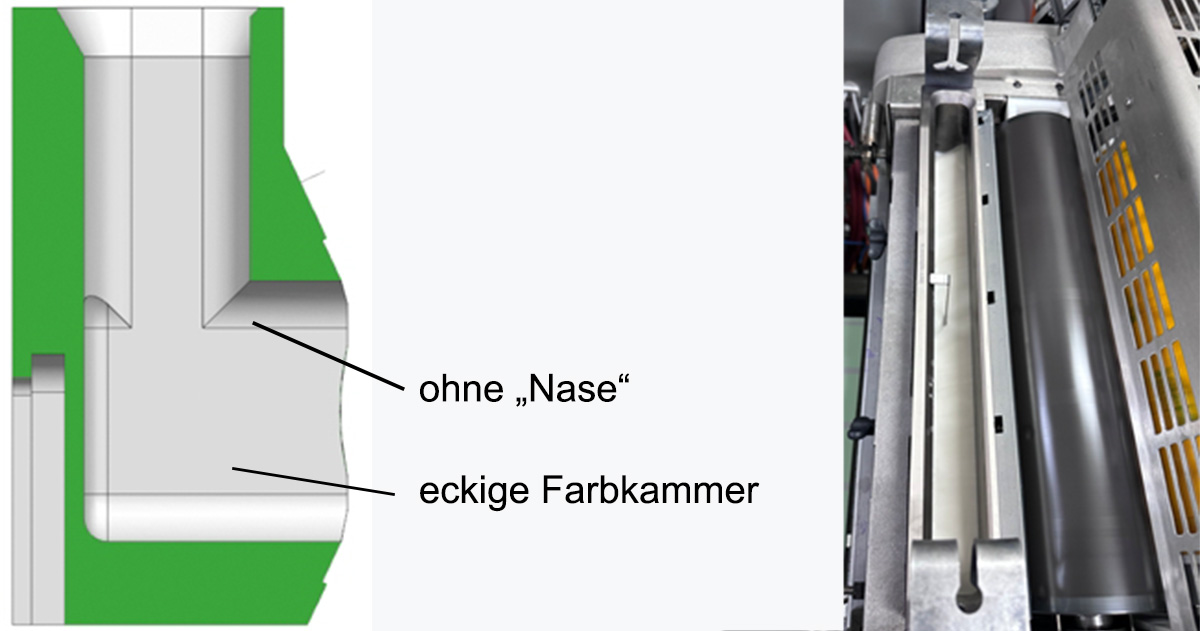
The effect is even more evident in productivity: whereas the processes were previously limited to 20 or 30 m/min due to unstable processes, the adjustment of the chambered doctor blade system resulted in a sustainable and significant increase in performance in production performance.
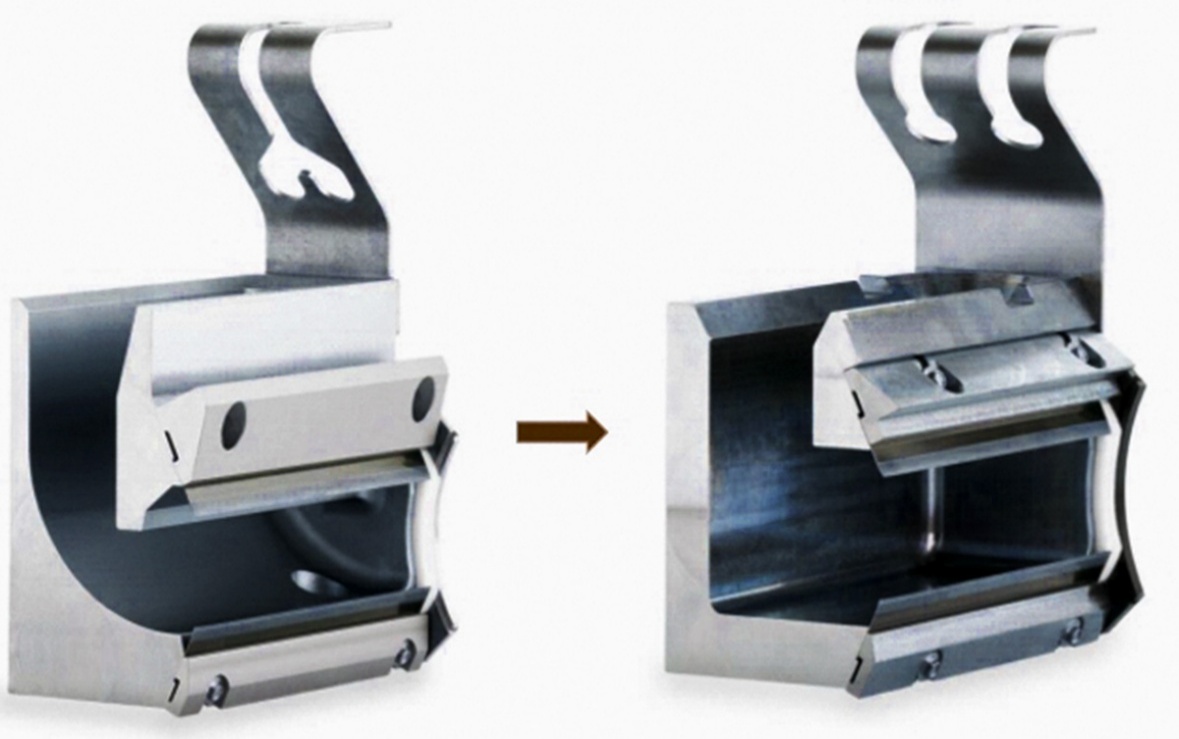
To properly appreciate the benefits of the new angular design of the ink chamber, it is worth taking a look at the strengths of the curved geometry, which is still used in various ink systems today. The curved ink chamber design was developed at a time when LED inks were not yet available on the market, or were available to a very limited extent. At higher printing speeds, the curved geometry facilitates efficient ink transfer to the anilox roller. It works reliably with most inks and varnishes, meaning that a change in geometry is only necessary if previously described problems such as ink foaming, ink spitting and blade jumping occur.
The supposed solution: dip roller
While Gallus has continued to develop chamber doctor blade technology, other solutions are also available on the market: a return to the open dip roller system. At first glance, this seems plausible. Dip rollers are better at handling high-viscosity inks and ensure consistent ink transfer through direct contact. However, this approach has its downsides. “Many people believe that dip rollers are easier to clean or better suited for certain applications,” says Alexander Feit. “But in practice, that is not the case.”
In fact, open systems require more ink and make quick job changes more difficult. Furthermore, they reach their limits at higher printing speeds – not least due to increased spitting and so-called ghosting effects. And, as press speed increases, a higher dot gain is generally the result. “We initially considered dip rollers as well,” admits Alexander Feit. “But in the end, we made a conscious decision against them – because the disadvantages outweigh the advantages.”
“We initially considered dip rollers as well,” admits Alexander Feit. “But in the end, we made a conscious decision against them – because the disadvantages outweigh the advantages.”
Alexander Feit, Customer Success Manager at Gallus
An often underestimated factor: the doctor blade
In addition to the ink chamber, another frequently underestimated factor has a major impact on process stability: the doctor blade. In practice, many users opt for inexpensive variants for cost reasons – with direct consequences for the printing process. “The doctor blade is a continuously wearing component,” explains Alexander Feit. “If the quality isn’t right, process disturbances such as ink spitting or blade jumping are practically inevitable.”
The quality and geometry of the doctor blade are decisive for process stability: while high-quality alloyed blades create a “lotus effect” allowing excess ink to run off, uncoated variants tend to accumulate ink on the back side—i.e., the open side of the blade. This results in droplets eventually falling back onto the anilox roller from where they are flung off—this is how ink spitting occurs, manifesting as visible defects in the printed image. This effect is exacerbated by inadequate blade geometry or an incorrect blade angle, which prevents the chamber from sealing cleanly and allows ink to accumulate in an uncontrolled manner.
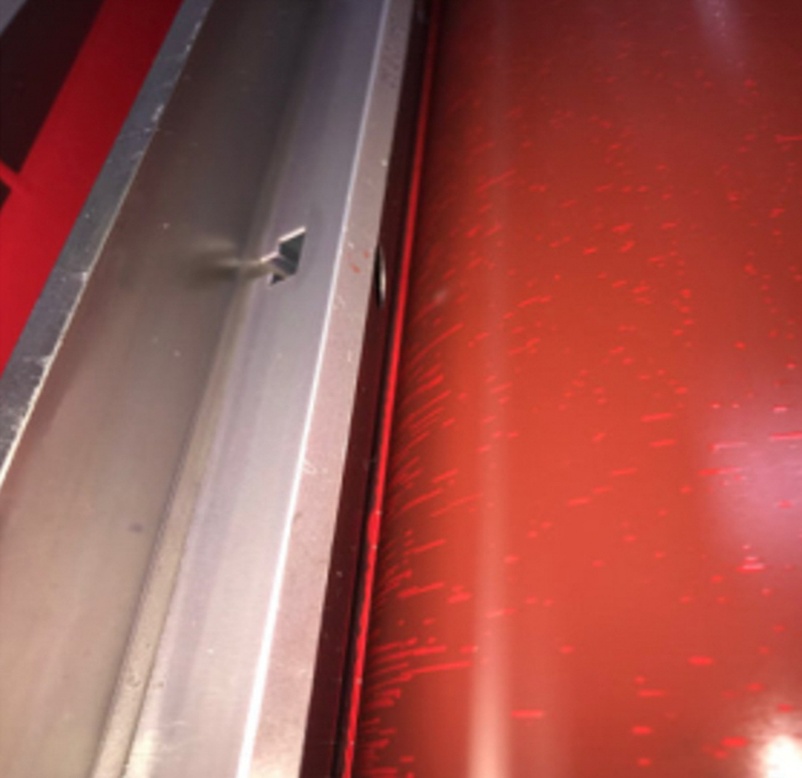
The design of the cutting edge also plays an important role. Modern doctor blades with lamellar geometry precisely control the ink flow, whilst simultaneously reducing the stress on the cutting edge. Similarly, stability and material thickness influence the behavior of the doctor blade during the printing process. Micro-vibrations on the surface of the anilox roller can further contribute to ink spitting—more stable doctor blades help to reduce these effects.
Based on these insights, Gallus has also revised the company’s doctor blade portfolio. The increased material thickness of 0.25 mm combines high performance with competitive pricing and helps to achieve smooth running and high process reliability.
There are now three product lines to choose from – Soft Line, Classic Line, and Top Line – each designed to meet different requirements in UV flexographic printing. These range from standard applications to particularly demanding printing processes with high requirements for stability, service life, and print quality.
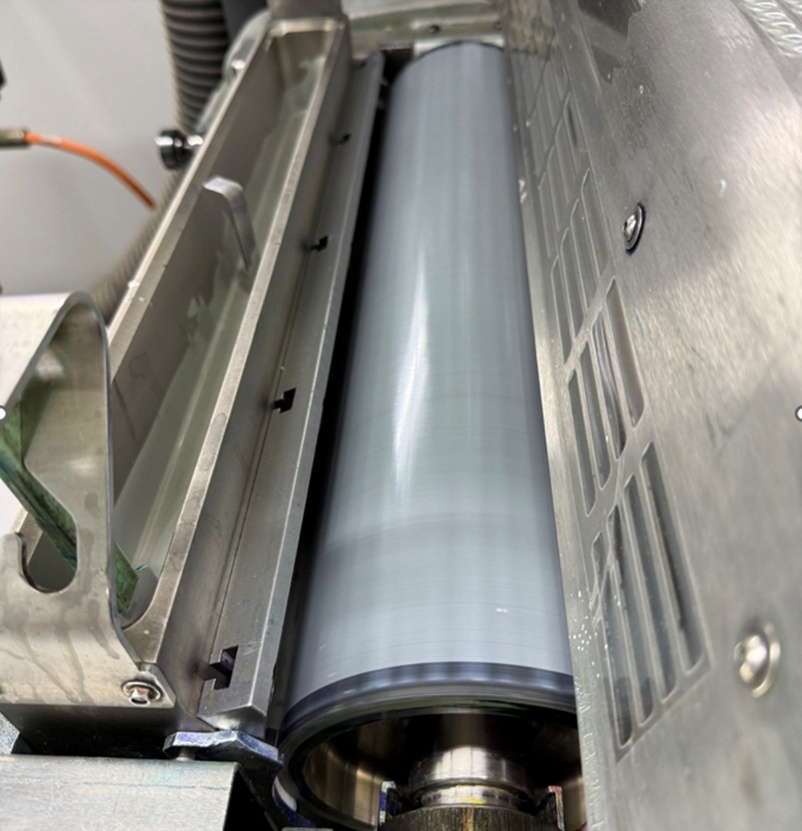
The new Gallus doctor blade portfolio
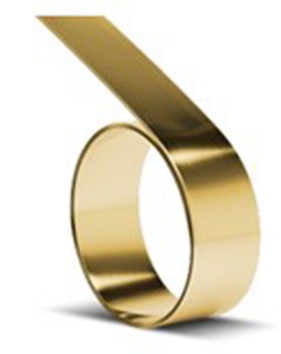
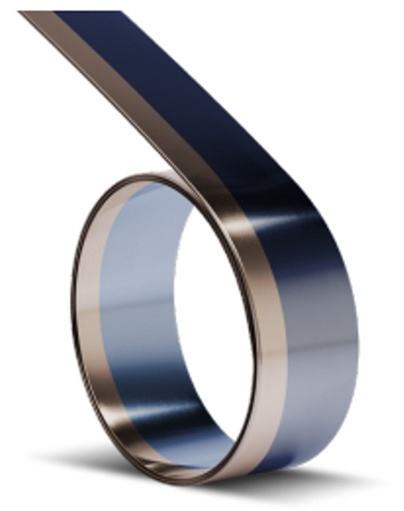
Soft Line
The Soft Line blade with its special coating significantly reduces ink adhesion and prevents ink spitting as well as streaking on the anilox roller. The soft design protects the anilox roller from abrasive damage and makes the blade ideal for use as an efficient containment blade.
- Reduces backdoctoring (ink build-up on the outside of the containment blade), which leads to ink spitting
- Suitable for use with inks and coatings
- High cost-efficiency for short and medium run lengths
- Beveled profile
- Corrosion protection
Classic Line
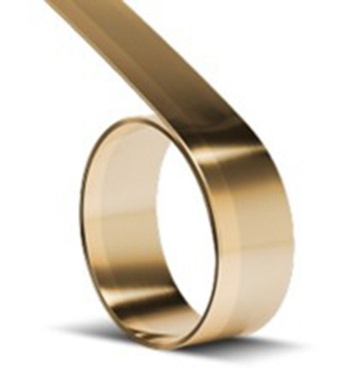
The Classic Line blade is the versatile standard for various printing applications. For medium to long run lengths, it offers a balanced combination of wear resistance, process stability, and economical service life:
- Reliable process performance
- High cost-efficiency for medium to long run lengths
- Suitable for any printing application
- Beveled profile
- Corrosion protection
Top Line
The Top Line blade is made of special high-performance steel and features a double coating, ensuring maximum stability and process reliability. As an effective troubleshooter, it ensures controlled printing processes even under demanding conditions:
- Suitable for high printing speeds with UV and water-based ink systems
- Offers high cost-efficiency for medium and long run lengths
- Suitable for highly abrasive inks and coatings
- Beveled profile
- Corrosion protection
Cleaning: the often overlooked key
Another decisive factor for a stable printing process is a consistently clean anilox roller. Even the slightest traces of ink residues in the cells of the anilox roller impair ink transfer and, beyond a certain level of contamination, become another cause of ink spitting. “The anilox roller’s job is to pick up ink and release it again,” emphasizes Alexander Feit. “If that doesn’t work cleanly, problems are inevitable.”
In addition to simple manual cleaning, cleaning units and modern laser systems offer an efficient way to reliably remove stubborn contamination, even deep within the cells.
A holistic approach rather than an isolated solution
Experience gained from numerous customer projects shows that, given the complex interplay of ink transfer, isolated measures fall short of providing a comprehensive solution. It is the perfect interaction of all components -ink, chamber, doctor blade, anilox roller, and doctor blade pressure – that determines the stability of the printing process. Or, as Alexander Feit puts it: “Ultimately, it is not about individual components. It is about everything fitting together and harmonizing.”
