
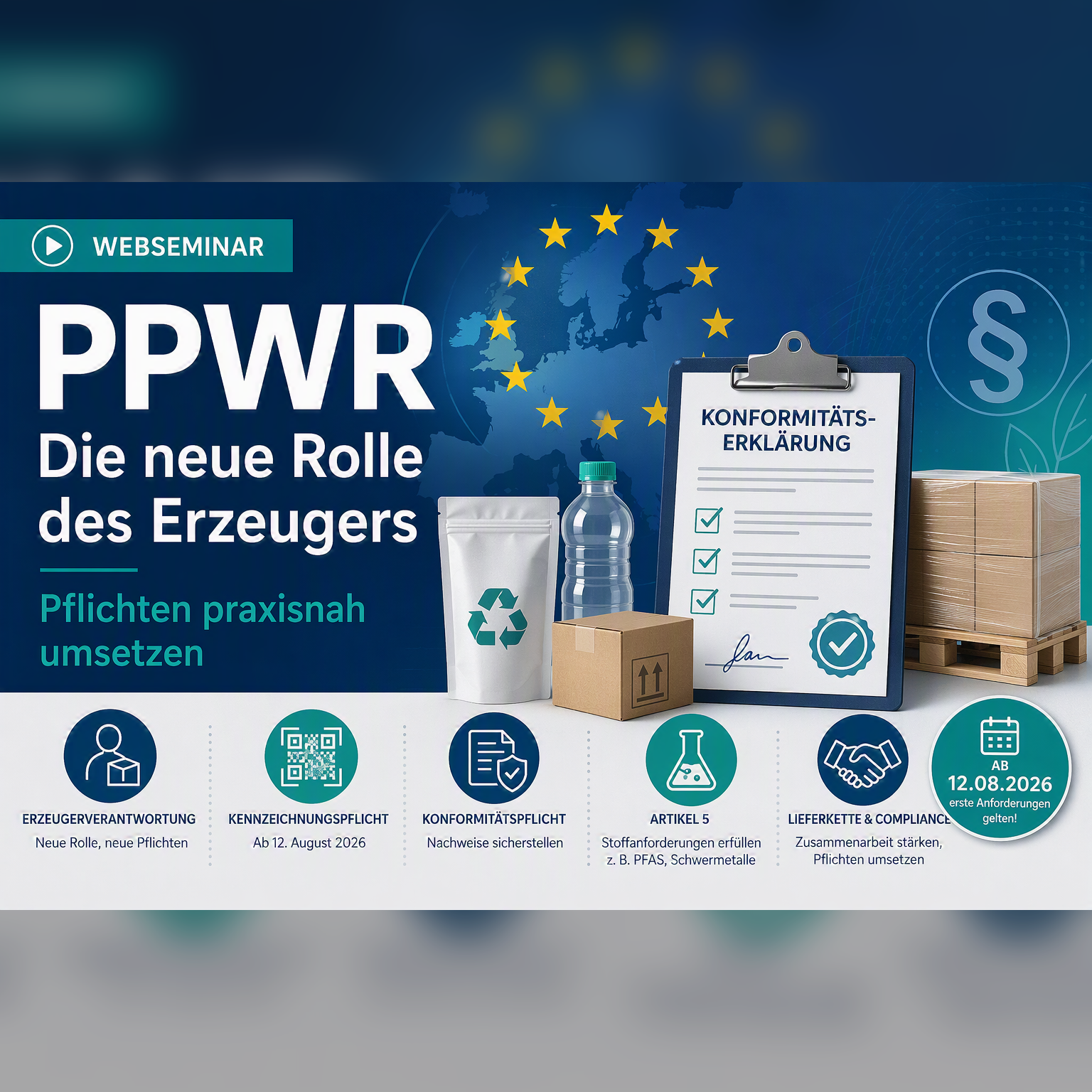
With key requirements of the European Packaging and Packaging Waste Regulation (PPWR) coming into force on 12 August 2026, many companies are faced with the question: Who is actually considered a “manufacturer” within the meaning of the regulation, and what specific obligations arise from this? Exactly these questions were the focus of the web seminar The New Role of the Manufacturer under the PPWR – Practical Implementation of Obligations, presented by Jie Zhang (Interzero).
Who is a Manufacturer under the PPWR?
A central topic of the web seminar was the clear distinction between the various actors along the value chain. For the first time, the PPWR clearly differentiates between the roles of manufacturer, producer, importer, distributor, and supplier. In this context, the manufacturer is responsible for the technical conformity of the packaging, whereas producers primarily have to fulfill waste law obligations within the framework of Extended Producer Responsibility (EPR).
Particularly relevant in practice is the question of who is considered the manufacturer of packaging. In principle, this is the economic operator who manufactures a packaging or has packaging designed or manufactured under its own name or trademark. Of course, the exemption for small companies should also be taken into account when determining roles. Using numerous examples, it was highlighted that determining the specific role requires a careful examination of the respective supply and production chain.
New Interpretation for Transport Packaging
Another focus was the European Commission’s current interpretation regarding flexible and neutral transport packaging. While it was previously widely assumed that certain transport packaging is only considered packaging when it is actually used, the Commission now takes the view in the updated FAQs (as at August 2026) that items such as films, adhesive tapes, or cardboard boxes can already be classified as finished packaging in their empty state. As a result, in many cases, manufacturer responsibility shifts to the actual producer of these packaging items. At the same time, it was pointed out that technical discussions on this topic are ongoing and further clarifications are expected.
Labeling Obligations as of 12 August 2026
The new labeling obligations for manufacturers were explained in detail. Packaging must be clearly identifiable and contain information about the manufacturer. This information can be provided directly on the packaging, via digital data carriers such as QR codes, or in accompanying documents. The aim is to ensure clear traceability of packaging for market surveillance authorities and economic operators.
At the same time, a distinction was made between these new manufacturer labeling and the future harmonized European disposal labeling according to Article 12 PPWR. For the latter, the necessary implementing acts are currently being prepared by the European Commission.
Declaration of Conformity and Technical Documentation
The largest part was devoted to the new conformity obligation. Packaging may only be placed on the market if its conformity with the relevant PPWR requirements has been demonstrated. This requires a conformity assessment procedure, technical documentation, and a declaration of conformity.
Special attention was paid to the technical documentation. It forms the core of the proof system and must transparently document which requirements were tested, which standards and evidence the assessment is based on, and how potential risks of non-conformity are evaluated. The declaration of conformity then serves as the manufacturer’s legally binding confirmation.
Article 5: Focus on Substance Requirements
In the final part of the web seminar, the requirements of Article 5 PPWR were discussed. The main focus was on heavy metal restrictions as well as the new requirements for PFAS. Particularly helpful were the practical guidelines on providing proof of compliance. In many cases, qualified supplier declarations can already serve as an important foundation for technical documentation. For PFAS, a phased testing process is recommended, initially based on total fluorine analysis.
Conclusion
The web seminar clearly showed: The role of the manufacturer is one of the most important innovations of the PPWR. Companies should analyze their roles in the supply chain early on, evaluate their packaging portfolios, and establish the necessary processes for documentation and conformity assessment. The coming months will be used in particular to gather missing information from suppliers and step-by-step build up the technical documentation.
Watch Recording
The complete web seminar with Jie Zhang (Interzero Circular Solutions Germany GmbH) on demand.
Watch now →Matching Seminars
Seminars and web seminars on circular economy, PPWR, and recycling
Discover topics →Check Recyclability
Optimizations in connection with the Packaging and Packaging Waste Regulation (PPWR) at Innoform Testservice.
To the laboratory →