
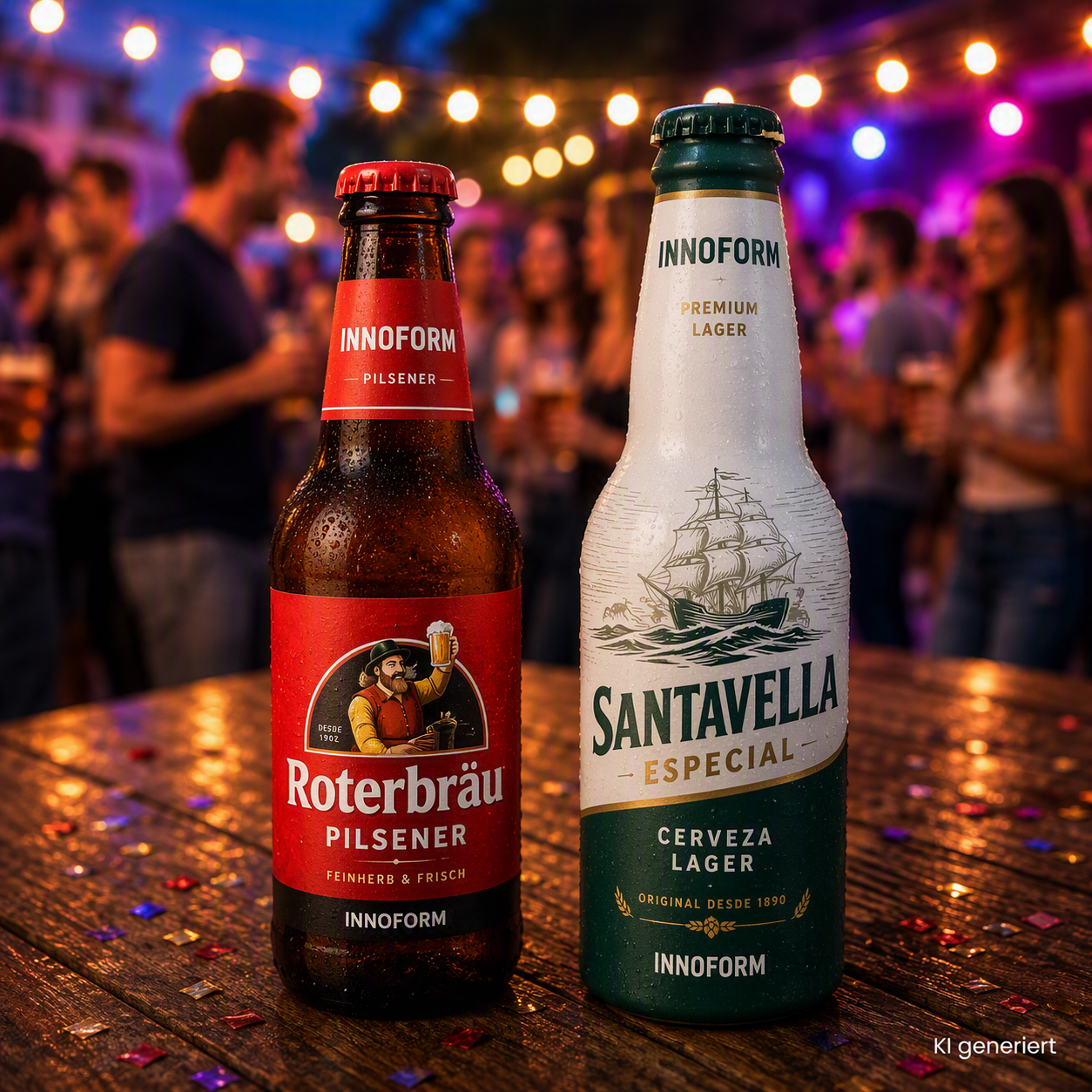
Two beer bottles are standing on the table. On the left, a red glass bottle. On the right, a white metal bottle. If you spontaneously ask consumers about the more sustainable packaging, the answer is usually clear: Glass, of course.
After all, glass feels natural, high-quality, and somehow environmentally friendly. But unfortunately, it is not quite that simple. Or luckily not. Otherwise, we, the packaging experts, would have significantly less to discuss.
Many people would spontaneously choose the red glass bottle. Glass appears natural, high-quality, and sustainable. The white metal bottle, on the other hand, often suffers from an image problem. Metal sounds like industry, glass like tradition. But it is precisely this first impression that can be misleading.
Anyone wishing to evaluate the sustainability of packaging should look beyond just the material. What matters far more is the entire lifecycle of the packaging. This includes production, transport, use, reuse, and recycling. And that is precisely where the discussion becomes much more interesting than many might think.
Why glass is not automatically the most sustainable solution
Glass possesses many positive properties. It is taste-neutral, chemically stable, and can theoretically be recycled infinitely without loss of quality. That is why glass has been considered the benchmark for high-quality beverage packaging for decades.
The disadvantage, however, lies in its weight. A typical glass beverage bottle often weighs between 180 and 350 grams. A comparable aluminium package frequently weighs just 15 to 30 grams. Depending on the design, a glass bottle can thus be ten to twenty times heavier than a comparable metal container.
This weight has consequences. Heavier packaging requires more material, more energy during manufacturing, and more fuel during transport. Especially for beverages, which are often transported over long distances, this results in a significant proportion of the environmental impact.
In other words: the environment does not care which material seems more appealing. It cares about mass, energy input, and transport routes.
Aluminium: The underestimated challenger
At first glance, aluminium seems to stand little chance against glass. Indeed, the production of primary aluminium is extremely energy-intensive. That is undisputed.
However, the story changes significantly as soon as recycling comes into play. Aluminium is one of the few materials that can be repeatedly melted down and reused with almost no loss of quality. Producing recycled aluminium requires only a fraction of the energy of primary production. Technical literature cites energy savings of around 95 percent.
Added to this is its low weight. When a truck transports glass, a significant portion of the payload consists of packaging weight. With aluminium, a much larger share of the transported mass actually consists of the beverage rather than the packaging.
So it is no wonder that numerous life cycle assessments (LCAs) for single-use packaging reach a surprising conclusion: aluminium packaging often performs better than comparable single-use glass bottles.
The decisive difference: Single-use or reusable?
Before the glass industry begins to hyperventilate, however, it is worth taking a closer look.
The comparison changes completely as soon as glass is used in a reusable system. A reusable bottle spreads its manufacturing impact over many cycles. If it is refilled 20, 30, or even 50 times, its environmental footprint improves significantly.
This is precisely where the true strength of glass lies: not as single-use packaging, but as part of a functioning reusable system.
That is why the debate “Glass or metal?” often leads in the wrong direction. The far more important question is:
Single-use or reusable?
Because a well-organized reusable solution may be significantly better for the environment, regardless of whether the material is glass, plastic, or metal.
How the PPWR is changing the discussion
With the new European Packaging and Packaging Waste Regulation (PPWR), the focus of the packaging world is shifting significantly. The regulation aims to reduce packaging waste, strengthen the circular economy, and design packaging more efficiently. The EU sets specific packaging waste reduction targets of 5 percent by 2030, 10 percent by 2035, and 15 percent by 2040 compared to the 2018 baseline.
The waste hierarchy plays a particularly crucial role here. The core idea is:
- Prevent packaging waste.
- Reuse packaging.
- Recycle materials.
- Disposal only as a last resort.
This makes it clear: recycling remains important, but it is not automatically the best solution. From the perspective of the PPWR, packaging that does not become waste in the first place or can be reused multiple times is fundamentally preferable to packaging that is merely highly recyclable.
The biggest sustainability myth in our industry?
Perhaps we should ask an uncomfortable question more frequently in the future:
Could the supposedly sustainable single-use glass bottle actually be one of the biggest sustainability myths in the packaging market?
The answer is neither a definitive yes nor a definitive no. Rather, it is:
It depends …
on the weight. On the transport routes. On the recycling rate. On the recyclate content. On the collection rate. And above all, on the number of actual reuses.
Anyone who assesses packaging solely on the basis of the material therefore often fails to take the full picture into account. What matters is the interaction of all factors within a functioning circular system.
| Criterion | Aluminium Bottle (330 ml) | Single-Use Glass Bottle (330 ml) |
|---|---|---|
| Tare Weight | approx. 25 – 35 g | approx. 180 – 220 g (lightweight glass) |
| Packaging Unit Cost | High (approx. 2x to 3x higher price) | Very low (mass standard) |
| Logistics & Freight Costs | Very low (minimal dead weight) | High (heavy freight weight) |
| Breakage Risk / Handling | 0 % breakage risk (shatterproof) | approx. 0.5 – 2 % breakage & scrap rate |
| CO₂ Footprint (Virgin Material) | Higher impact (~ 10 – 12 kg CO₂e/kg Al) | Lower impact (~ 0.9 – 1.2 kg CO₂e/kg glass) |
| CO₂ Footprint (High Recycled Content) | Excellent (up to 95 % energy savings via PCR) | Moderate leverage (~ 3 % savings per 10 % broken glass) |
| Product Protection / Light Barrier | 100 % UV & visible light barrier (prevents lightstruck flavor) | Light-permeable (especially white and green glass) |
AI research
Conclusion
The red glass bottle does not automatically win. The white metal bottle does not automatically lose.
For single-use packaging, many facts point in favor of aluminium. In functioning reusable systems, glass can play to its strengths. The real key takeaway is therefore:
The most sustainable packaging is often not the packaging that looks the most sustainable.
That is precisely why, under the PPWR, the packaging industry will need to talk less about materials in the future and focus much more heavily on circular loops, reuse, and resource efficiency.
References
European Commission
- Packaging & Packaging Waste Regulation (PPWR)
https://environment.ec.europa.eu/topics/waste-and-recycling/packaging-waste/packaging-packaging-waste-regulation_en - Packaging Waste Overview
https://environment.ec.europa.eu/topics/waste-and-recycling/packaging-waste_en
Studies on Beverage Packaging
- International Aluminium Institute: Comparing the Carbon Footprints of Beverage Containers
https://international-aluminium.org/resources/comparing-the-carbon-footprints-of-beverage-containers/ - International Aluminium Institute: Factsheet Beverage Container Carbon Footprints
https://international-aluminium.org/wp-content/uploads/2024/04/Comparing-the-carbon-footprints-of-beverage-containers.pdf
Editorial note: The environmental impact of beverage packaging always depends on the specific application. General statements such as “glass is more sustainable than aluminium” or “metal is more sustainable than glass” are technically unfounded. For a sound evaluation, life cycle assessments (LCAs) based on the respective market and usage scenarios are required.
