
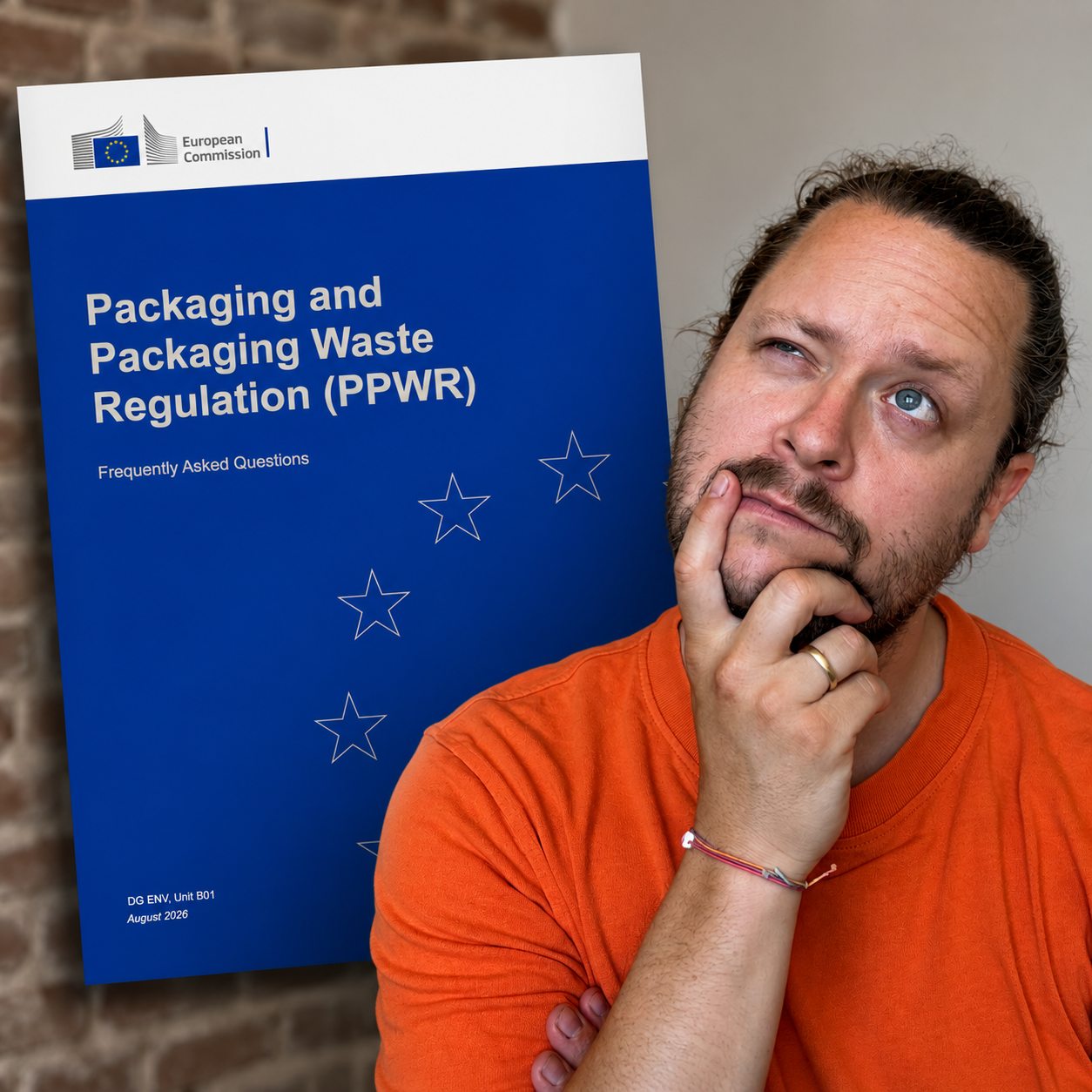
The Packaging and Packaging Waste Regulation will generally apply from 12 August 2026. Some of its most far-reaching requirements, including detailed recyclability criteria and minimum recycled-content targets, will only become effective at a later stage. Nevertheless, practical implementation needs to begin now.
The European Commission’s updated PPWR FAQ from August 2026 addresses numerous questions concerning responsibilities within the supply chain, substances of concern, recyclability, recycled content and conformity documentation.
For manufacturers, suppliers and users of flexible plastic packaging and functional paper packaging, seven points are particularly relevant.
1. The focus is not the raw material, but the complete packaging unit
Conformity assessment generally applies to the complete packaging unit.
For packaging consisting of a container, closure, label or lidding film, a single declaration of conformity may therefore be sufficient. However, it must include the relevant information for all components of that packaging unit.
For flexible packaging, this may include:
- film substrates,
- printing inks,
- laminating adhesives,
- coatings and lacquers,
- zippers, valves and closures,
- labels and other applications.
The same principle applies to functional paper packaging. The properties of the base paper alone are not decisive. Barriers, polymer layers, coatings, printing inks, lacquers and adhesives can all influence both regulatory conformity and recyclability.
The practical consequence: A positive recyclability assessment of the main material alone is not enough. What matters is the actual packaging system placed on the market.
2. Suppliers must provide data, but the brand owner often remains responsible
The FAQ provides further clarification on the distribution of responsibilities within the supply chain.
Suppliers of packaging, packaging materials and packaging components must provide the manufacturer with the information and documentation needed to demonstrate PPWR conformity. Relevant technical information cannot simply be withheld from the customer.
However, the term “manufacturer” can be misleading.
Where packaging is placed on the market under the name or trademark of a company, the brand owner or commissioning company may be considered the manufacturer under the PPWR — even when the packaging itself is produced by another company or the product is packed by a contract packer.
An important factor may be who defines the packaging design and technical specifications.
This results in a shared division of tasks.
Film, paper and packaging suppliers should:
- provide material and structural data,
- document relevant substances,
- supply information on recyclability,
- verify recycled-content levels,
- provide auditable technical documentation.
Brand owners, packers and other PPWR manufacturers should:
- consolidate the information received,
- assess the finished packaging unit,
- compile the technical documentation,
- issue the EU declaration of conformity,
- assume overall legal responsibility.
Contractual agreements can define responsibilities and liabilities within the supply chain. However, the manufacturer’s regulatory responsibility cannot simply be transferred in full to a supplier.
3. A technical packaging file will be required
Before placing packaging on the market, the responsible manufacturer must generally:
- carry out the conformity assessment procedure,
- prepare an EU declaration of conformity,
- compile the technical documentation,
- ensure that the packaging can be clearly identified,
- provide the manufacturer’s name and contact details.
The technical documentation must be retained for five years for single-use packaging and ten years for reusable packaging.
Identification may be achieved through a type, batch or serial number, or another suitable element. This does not necessarily mean that every individual packaging unit requires its own unique serial number.
For unprinted films, roll stock, premade pouches, blanks or sheets of functional paper, one practical question is where such information should appear.
Where the size, shape or nature of the packaging does not allow the information to be placed directly on the packaging, accompanying documentation may be used. However, this will need to be assessed on a case-by-case basis.
Companies should therefore establish a digital packaging-data structure linking at least the following information:
- article and specification numbers,
- material structures and layer weights,
- polymer and fibre types,
- coatings and barrier layers,
- printing inks, lacquers and adhesives,
- supplier and batch information,
- declarations and compliance evidence,
- recyclability assessments,
- recycled-content evidence,
- modifications and version histories.
4. Recyclability requirements apply across materials, but important details are still pending
From 2030, packaging will generally need to comply with the applicable design-for-recycling criteria.
This requirement will apply to single-use and reusable packaging as well as to sales, grouped and transport packaging. The detailed technical criteria will be defined through further delegated legislation.
The requirements will affect both plastic packaging and functional paper packaging.
For flexible plastic packaging, relevant questions will include:
- Can the structure be assigned to a defined recycling stream?
- Do foreign polymers, adhesives, lacquers or printing inks interfere with recycling?
- Can the required barrier performance be achieved with a recycling-compatible structure?
- How will closures, valves, zippers and labels be assessed?
- How does the packaging behave under real sorting and recycling conditions?
For functional paper packaging, the relevant questions include:
- Which waste and recycling stream is intended for the packaging?
- How do polymer coatings and barrier layers affect fibre recovery?
- Can the fibres be sufficiently separated and recovered during recycling?
- Do wet-strength agents, coatings, adhesives or printing inks interfere with recycling?
- Will the packaging be classified and assessed as paper packaging or as a composite?
The FAQ does not yet provide final technical thresholds for all these packaging structures. It does, however, confirm that the assessment must take account of the packaging unit and its components.
The terms “paper-based” and “mono-material” are therefore not substitutes for a robust recyclability assessment.
5. Recycled-content targets also affect flexible packaging and plastic components in paper-based structures
The PPWR’s recycled-content targets generally apply to plastic parts of sales, grouped and transport packaging.
The first step is to determine whether the packaging is contact-sensitive. The relevant polymer must then be identified.
One example addressed in the FAQ is pallet stretch film. For non-contact-sensitive plastic packaging made from polymers other than PET, the regulation sets a minimum recycled-content target of 35% by 2030.
For contact-sensitive plastic parts made from polymers other than PET, the relevant target is 10% by 2030.
This is not only relevant to conventional plastic packaging. Functional paper packaging can also contain plastic components, such as:
- extrusion coatings,
- film laminates,
- plastic windows,
- closures,
- plastic labels,
- separate polymer barrier layers.
Plastic parts representing less than 5% of the total weight of the packaging unit may be exempt from the recycled-content requirement under certain conditions. This exemption relates specifically to plastic parts.
Adhesives, coatings and printing inks are not themselves treated as plastic for the purpose of the recycled-content obligation. However, this does not make them irrelevant to other PPWR requirements, such as recyclability or restrictions on substances.
The recycled-content calculation is expected to be based on an average per manufacturing plant, year, packaging type and packaging format. Suppliers will need to provide the responsible manufacturer with the data required for this calculation.
The final calculation and verification methods will be specified in implementing legislation.
6. PFAS requirements concern the complete food-contact packaging unit
The PPWR establishes concentration limits for PFAS in food-contact packaging from 12 August 2026.
The restrictions do not only concern intentionally added PFAS. Unintended PFAS content may also be relevant.
For flexible packaging and functional paper packaging, one point is particularly important: the limits apply to the complete packaging unit, including:
- printing inks,
- lacquers,
- adhesives,
- laminating adhesives,
- coatings,
- other functional and auxiliary layers.
The European Commission does not currently intend to publish an exhaustive list of individual PFAS substances and CAS numbers. The requirements generally apply to substances falling within the PFAS definition used by the PPWR.
At the same time, harmonised testing procedures are still being developed. Total fluorine and total organic fluorine measurements are being discussed as possible starting points for monitoring.
Companies should therefore not rely solely on a general “PFAS-free” declaration from a supplier. A more robust approach would include documented information on:
- intentionally added fluorinated substances,
- possible PFAS sources in raw materials and formulations,
- the analytical methods used,
- detection limits,
- the assessment of the complete packaging structure.
7. Environmental claims will become more difficult
Claims such as “recyclable”, “contains recycled material” or “environmentally friendly” will need to be linked much more closely to legal requirements and supporting technical documentation.
According to the FAQ, a voluntary claim regarding recycled content may only be made where the stated recycled-content level exceeds the applicable legal minimum.
The calculation and verification method will be specified through an implementing act.
This may create an unfamiliar situation for some companies. A packaging structure could contain 35% recycled material and fully comply with the statutory target, but the mandatory share could not automatically be presented as an additional voluntary environmental benefit.
For paper and flexible plastic packaging, this means that companies should:
- clearly specify which packaging component a claim refers to,
- avoid presenting legally required properties as voluntary achievements,
- avoid deriving recyclability solely from material descriptions,
- document the evidence and assessment methods used,
- coordinate claims across marketing, purchasing, technical and legal departments.
What companies should do now
Businesses should not wait until every delegated act, implementing act and technical standard has been published. Many of the necessary foundations can already be established.
For film, paper and packaging manufacturers
- Structure the product portfolio by packaging type and format.
- Record complete material structures in a digital system.
- Update supplier declarations on substances, PFAS and recycled content.
- Add PPWR-relevant information to technical data sheets.
- Define internal responsibility for technical documentation.
- Review existing recyclability assessments.
- Explain clearly to customers which data will be supplied and which assessments remain the customer’s responsibility.
For suppliers of raw materials, inks, lacquers, adhesives and coatings
- Make substance information available throughout the supply chain.
- Do not restrict PFAS enquiries to intentionally added substances.
- Document the effects of products on sorting and recycling processes.
- Ensure traceability of batches, formulations and product changes.
- Develop standardised and preferably machine-readable customer documentation.
For brand owners, fillers and packaging users
- Determine who acts as the PPWR manufacturer for each packaging configuration.
- Update supplier contracts and packaging specifications accordingly.
- Establish a technical packaging file for each packaging type.
- Record every component of the packaging unit.
- Manage packaging modifications through a controlled change-management process.
- Verify environmental claims against the technical documentation.
- Document stock levels and the date on which packaging is placed on the market.
Conclusion
The PPWR is shifting the packaging discussion away from general material claims and towards verifiable packaging data.
In future, a film manufacturer will not only need to explain the barrier properties of a structure. The manufacturer will also need to provide the information that customers require to demonstrate PPWR conformity.
A supplier of functional paper packaging will not be able to rely on the argument that a solution is simply “paper-based”. The supplier will need to explain how the complete structure is designed, which recycling stream it is intended for, and how coatings, barriers and additives affect its recyclability.
Brand owners and fillers will then need to consolidate these data into robust technical documentation for the finished packaging unit.
PPWR compliance is therefore not created at the end of the supply chain. It can only be achieved through cooperation across the entire supply chain.
