
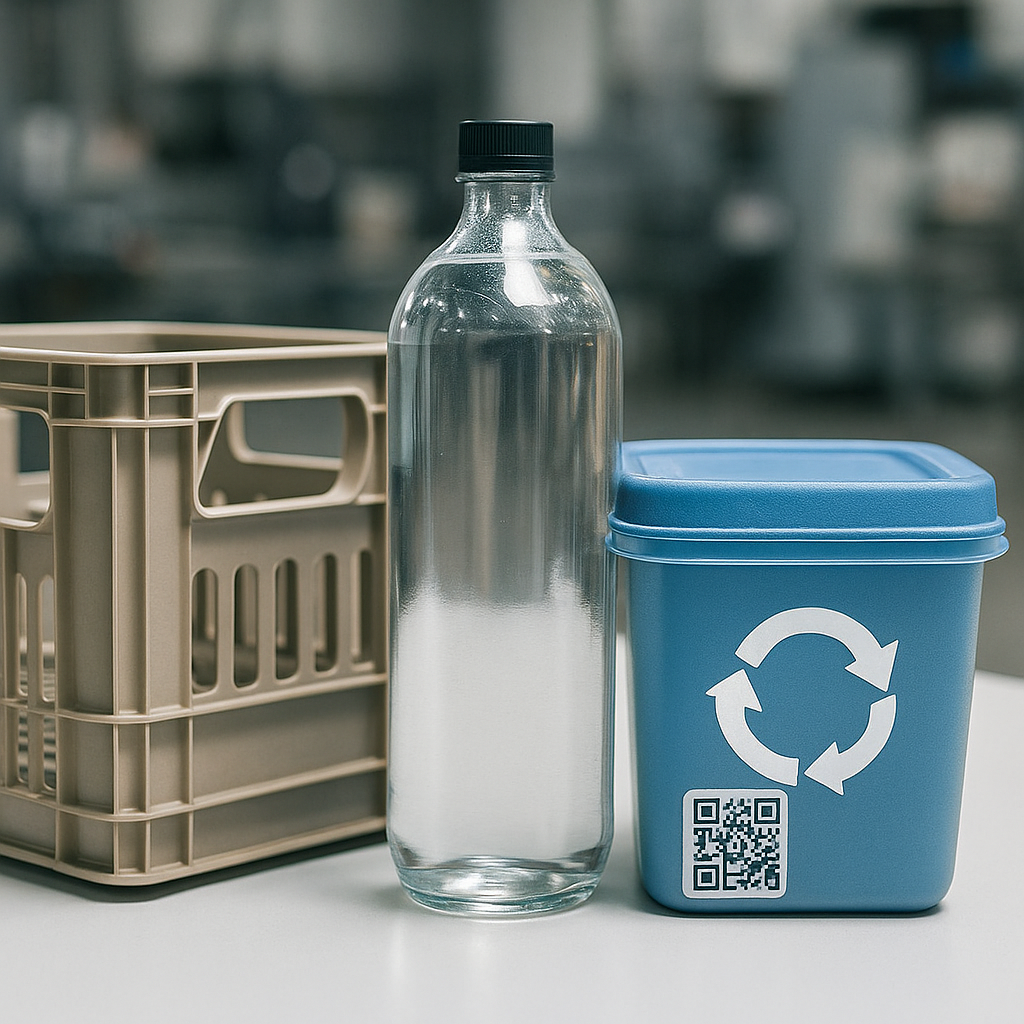
Reuse in the focus of the PPWR
The EU Packaging Regulation (PPWR) asks a key question for the industry: When will packaging actually be considered reusable in future – and what requirements are necessary for this?
Inno-Talk highlighted the most important points relating to the term “reuse”. This blog post summarises the key messages in an understandable way and classifies them for practical application.
Reuse instead of “recyclable” – the terminology of the PPWR
In everyday life, we talk about “reusable”, but the PPWR uses the term “reuse”.
This means that packaging must be designed in such a way that it can be used multiple times – within the framework of a regulated recycling system.
The regulation thus clarifies our common understanding of reusable packaging at a legally relevant level: not all robust packaging is automatically reusable within the meaning of the PPWR. It must be integrated into a system that actually enables and documents reuse.
Basic requirement: Survive more than one cycle
The first, seemingly simple but crucial question is: To what extent can packaging survive more than one cycle of use and return?
This results in specific technical requirements:
- The packaging must be mechanically stable enough to withstand several cycles without significant damage.
- Functional properties (e. g. tightness, barrier, manageability) must be maintained over the intended number of cycles.
- Cleaning, drying and, if necessary, relabelling must not weaken the packaging in an impermissible manner.
This robustness is a fundamental requirement for packaging to be considered reusable or reusable within the meaning of the PPWR.
From “or” to “and”: recycling quotas also apply to reusable items
A particularly important point: an earlier version of the regulations stated that packaging must be either recyclable or reusable. This “or” has since been significantly tightened.
Today, the following applies: Reusable (multi-use) packaging is also subject to the requirements regarding recycled content and quotas that apply to single-use packaging.
This has several practical implications:
- Reusable packaging is not a “free pass” to circumvent recycling quotas.
- Design for Recycling remains essential even with reusable packaging.
- Material selection and system design must take into account both reuse and recycling at the end of life.
The PPWR therefore takes a holistic view of the circular economy – from reusable cycles to final material recycling.
Future minimum number of circulations – questions still to be answered
Another aspect that was addressed in the Inno-Talk: In future, there could be a mandatory minimum number of reuse cycles for certain product areas.
This raises questions:
- How is a “cycle” clearly defined and documented?
- What are the minimum quantities for each segment (e.g. beverages, takeaway packaging, transport packaging)?
- How are damage, loss or premature disposal handled?
These points are still subject to uncertainty. However, one thing is clear: anyone developing new reusable systems today should set realistic but ambitious targets for circulation figures and consider appropriate testing and monitoring concepts.
Technical requirements: Emptying and reuse without damage
The PPWR also requires that emptying and reuse must be possible “without significant damage”.
There are practical issues behind this:
- Can the packaging be completely emptied without being deformed, torn open or otherwise damaged?
- Will fasteners, handles, carrying aids, labels and functional elements remain functional over several cycles?
- Are cleaning and handling reliable and economically feasible in practice?
This makes it clear that reusability is not just a question of material, but a systemic problem – from geometry and closure and label design to logistics and returns.
Example: Bottles – disposable caps vs. reusable concept
Bottles and their caps are a clear example of this:
- In the case of disposable packaging, lids are now often permanently attached to the bottle (tethered caps) in order to prevent loss and ensure recycling.
- This is not necessarily the case with reusable bottles. Here, a removable cap can be useful because the bottle is cleaned and refilled within the system, while caps are handled or replaced separately.
These conceptual differences are reflected in the regulations. It is evident that the PPWR makes a very clear distinction between the system logic of single-use and reusable packaging – and this must be reflected in packaging design.
What does this mean for brands, converters and system operators?
A few guidelines can be derived from the points discussed in the Inno-Talk:
- Plan ahead: Reusable and disposable portfolios should be considered separately in strategic terms, but assessed jointly in regulatory terms.
- System before individual packaging: Only introduce reusable packaging if a functional return, cleaning and documentation system exists or can be set up.
- Combining design for reuse and recycling: Reusability and recyclability must not be played off against each other, but must be optimised together.
- Monitor regulations: Developments regarding minimum circulation figures and detailed obligations are dynamic – monitoring and regular review of your own concepts are essential.
Conclusion: Reusable packaging according to PPWR – it is worth taking a closer look
The PPWR significantly clarifies the term “reusable”. In future, reuse will not only mean robust packaging, but also clearly defined systems, documented circulation and compliance with recycled material and recycling requirements.
Innoform Coaching supports you with web seminars and Inno-Talks to help you understand these requirements, apply them to your packaging portfolios and develop practical solutions.
Transkript
When is packaging considered reusable, or when is it actually considered reusable? In the PPWR, the PPWR addresses the term reusability. So packaging must be reusable. Um, that corresponds, uh, literally to our understanding of reusable. Um, there are various definitions. Uh, I’ve picked out the most interesting and important ones. So for one, it’s obviously trivial: to what extent can packaging survive more than one cycle? That’s a fundamental requirement that needs to be fulfilled.
What was a very interesting point now for reusable packaging in general, there was also a significant change in the original version. It stated packaging must either be reusable or recyclable. Um, yeah. Now it has been supplemented by an end, meaning that these recycled content shares and quotas, which will also apply to single-use packaging in the future, now also apply to multi-use and reusable packaging.
I won’t go into the recycled content now, I think, I think that it’s been covered enough, but I’ll soon bring up other quotas from the reusable sector. Um, another point that might be interesting, although, um, in the future there might also be a minimum number of cycles that will be mandated for certain product areas, how that is defined and will come into effect. These are still uncertainties that the PPWR also brings with it in many areas.
And otherwise emptying and reuse must be, must be possible without, um, significant damage. So, um, even if you might know this from other bottle formats, lids on single-use packaging are already attached to the, to the bottle, but not necessarily on reusable bottles because that contradicts this very concept. Um, we also find this, uh, reflected in the regulation.
