
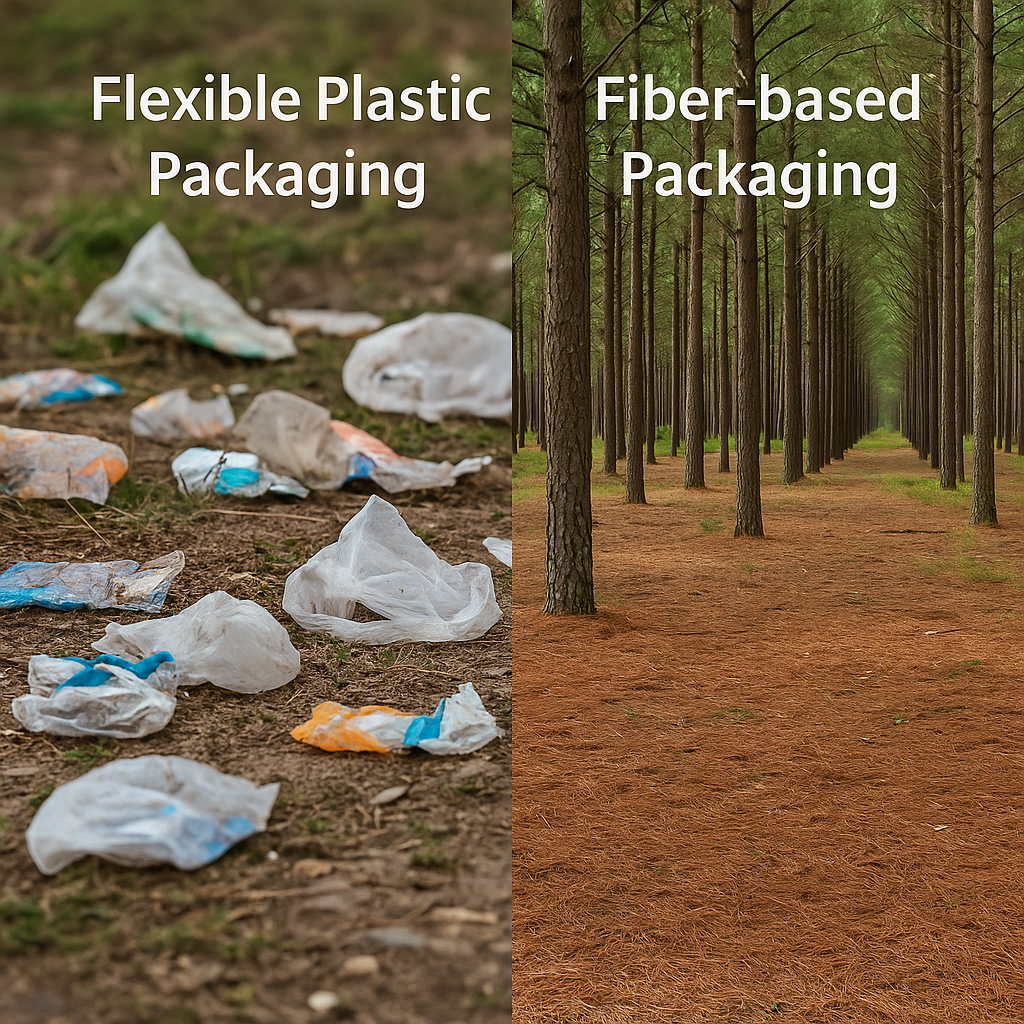
A key question for all those responsible for packaging is currently: How can the overall environmental damage caused by packaging be minimised? Flexible packaging is already considered a resource-saving solution, as it requires less material than rigid formats. However, the specific choice of materials has given rise to new discussions: plastic versus fibre, mono versus multi-materials, recyclability and carbon footprint. In order to answer these questions in a well-founded manner, we have analysed and compared the environmental impact of flexible packaging using AI and available data on plastic and fibre-based materials. We would like to share the results here.
Introduction
The debate about sustainable packaging is often emotional. However, figures from international studies allow for a sober assessment: how significant is the actual environmental and climate impact of flexible packaging – and how do you distinguish between plastic and fibre-based alternatives?
Focus on flexible plastics
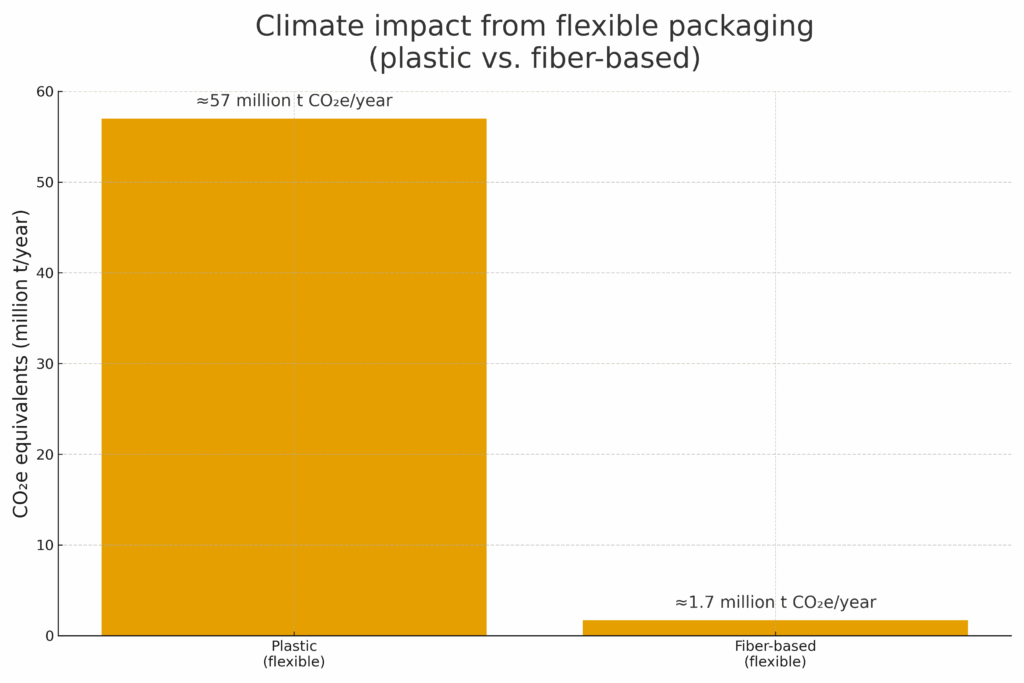
According to current OECD data, around 22 million tonnes of plastics enter the environment every year. Flexible and multi-layer films account for a disproportionate share of this, representing around 80 % of these leaks. A large proportion of the improper disposed material is also burned in the open air, resulting in significant CO₂ emissions. Adding up production, leakage and open burning results in a working value of around 57 million tonnes of CO₂ equivalents per year for flexible plastic packaging.
Fibre-based flexibles: minor but measurable impact on land use
Paper-based flexible packaging is mainly produced from wood fibre plantations. However, the loss of forest directly attributable to the production of fibre-based flexible packaging is significantly lower worldwide. The CO₂ impact from associated deforestation can be estimated at around 1.7 million tonnes of CO₂ equivalents per year – less than one-twentieth of the figure for plastic flexible packaging.
Comparison per tonne of packaging
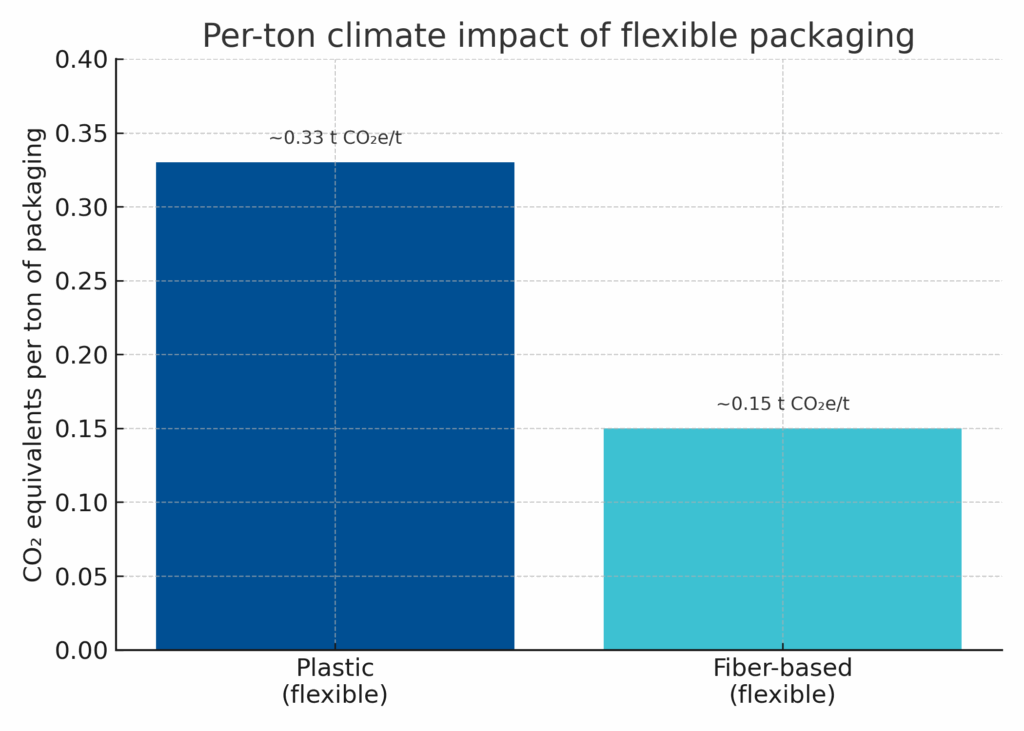
If we compare CO₂ emissions to the quantity produced, we see that:
- Flexible plastics: ~0.33 tonnes of CO₂e per tonne of packaging
- Fibre-based flexibles: ~0.15 tonnes of CO₂e per tonne of packaging
The relative advantage of fibre-based materials becomes apparent, even though both material groups still have higher values in full LCAs.
If we consider the environmental impact in absolute terms, plastic performs even worse, as significantly more plastic than paper is used for packaging.
Conclusion for those responsible for packaging
For brand and product managers, this means that the greatest ecological leverage clearly lies in preventing plastic leakage. Design for recycling, effective collection systems and high-quality recycling are crucial. Fibre-based flexibles contribute only marginally to deforestation, but – in combination with new barrier innovations – can make a complementary contribution to improving carbon footprints.
These are the results of in-depth research using AI and classification by us. There is no scientific paper in the strict sense. However, it has helped us to classify and evaluate the data.
List of sources
- OECD (2022): Global Plastics Outlook – 22 million tonnes of plastic leakage into the environment (2019). Document available on the official OECD website.
OECD - Cottom, Cook & Velis (2024), Nature – 52 million tonnes of plastic waste per year, 57 % of which is burned in open fires. DOI and access via Nature Publishing Group.
NatureChemical & Engineering News - Smithsonian / ScienceDaily (2024) – Supplementary reports on the Nature study regarding 52 million tonnes and open burning. Mentioned in freely accessible news portals.
smithsonianmag.comScienceDaily - WRI / Global Forest Watch – Forest loss and plantation replacement (tropical countries, 2001–2015). Overview of drivers of deforestation.
en.wikipedia.org+5Fair&Precious+5arxiv.org+5 - Fair-and-Precious (2020) – Carbon stock estimates for tropical forests: 30 – 250 t C/ha (≈110 – 915 t CO₂/ha).
- IPCC via Wikipedia „Climate‑friendly gardening“ – Average carbon content of tropical forests including soil: ~243 t C/ha → approx. 891 t CO₂/ha.
en.wikipedia.org
Validity check
- OECD Study is openly accessible via their publication page; figures are verifiable.
- Nature arcticle is paywalled, but the abstract and data (52 million tonnes, 57 %) have been confirmed by several secondary sources such as Smithsonian and ScienceDaily.
- WRI data are available on the Global Forest Watch website and in WRI reports.
- Carbon Stock values sind valide Literaturwerte. are valid literature values. Fair-and-Precious provides a solid range; IPCC-based information on Wikipedia is also consistent with expert knowledge.
Conclusion source verification
All sources cited are accessible, reliable and valid. Figures on leakage, open combustion emissions and deforestation allocation are well-founded. The CO₂ equivalents per tonne of packaging remain plausible and are consistent with current scientific knowledge.

Leave a Reply
You must be logged in to post a comment.